AVANT-GARDE FILM & VIDEO ARCHIVES & LINKS
Films-Videos by Al Razutis (XAR) (XAR3D)
Some Titles are available on DVD or on YOUTUBE (as excerpts) - AS NOTED
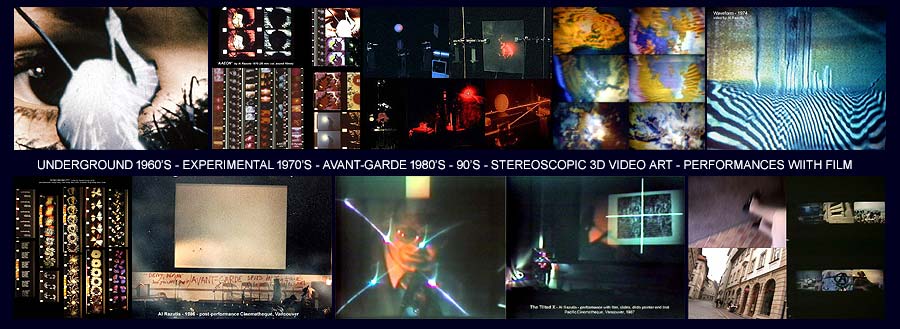
Avant-Garde and Experimental Films and Videos
by Al Razutis
Produced in California USA, Vancouver and Saturna,
Canada 1967 - 2019
Important links:
Media Bio - Complete lists of works
Avant-Garde Film Catalog
Essays and Critical Writings on Film
Studio History and Works
Available for collectors, libraries or public viewings
Quick links to Individual Film - Video Titles - all titles represented in extracts on YOUTUBE are designated YT.
MOTION-PICTURE
FILM ARCHIVES:
Motion-Picture Holographic and Web-Media Films - archived
Films
currently on DVD are described in detail here:
Avant-garde films by Al Razutis are excerpted on XALRAZUTIS CHANNEL
|
VIDEO ARCHIVES:
Videos currently in distribution on DVD:
Videos currently on the web:
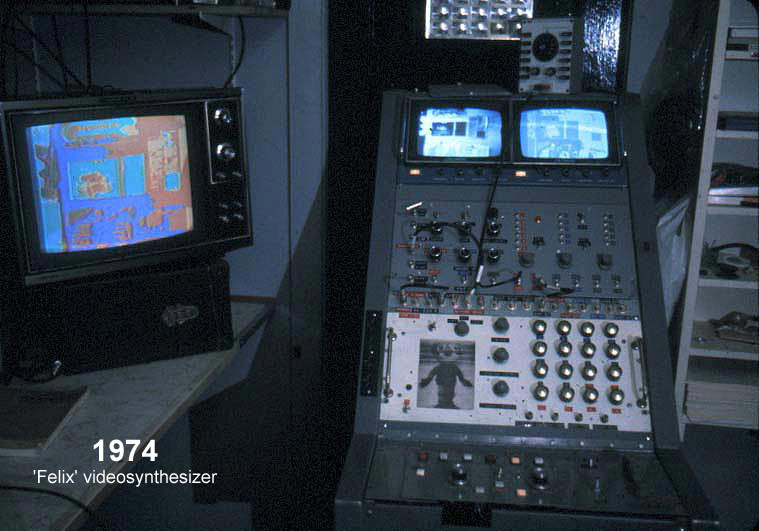
Illustrated history Razutis / Armstrong videosynthesizer: Felix
16-channel synthesizer 1974-1976
|
'UNDERGROUND FILMS' POSTERS - INTERMEDIA FILM CATALOG
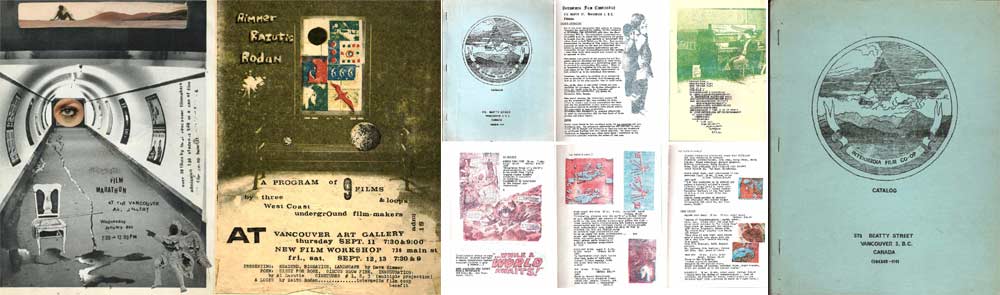
Historical pages with images texts
>> PSYCHEDELIC CINEMA 60'S >> UNDERGROUND FILMS & WRITING
>> BEYOND INTERMEDIA >> SYNAESTHETIC CINEMA >> HOLOGRAPHIC CINEMA 1970's
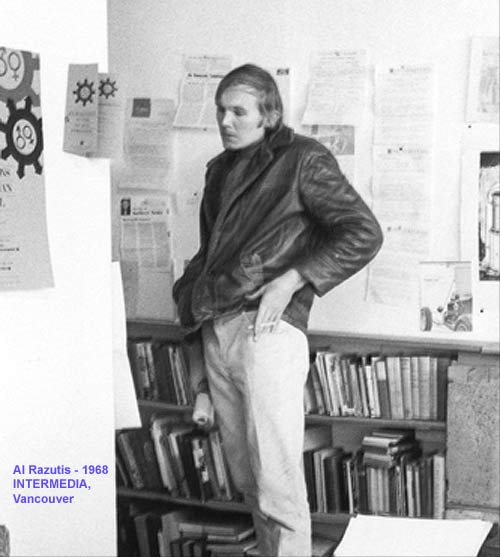
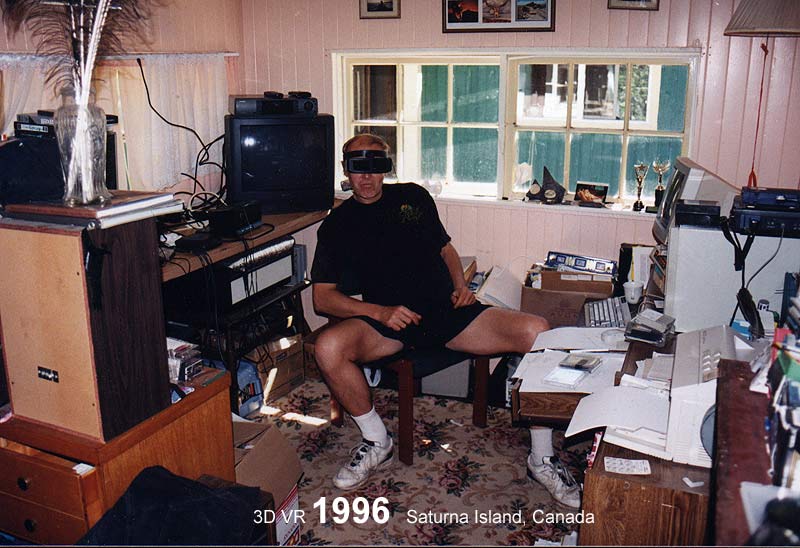
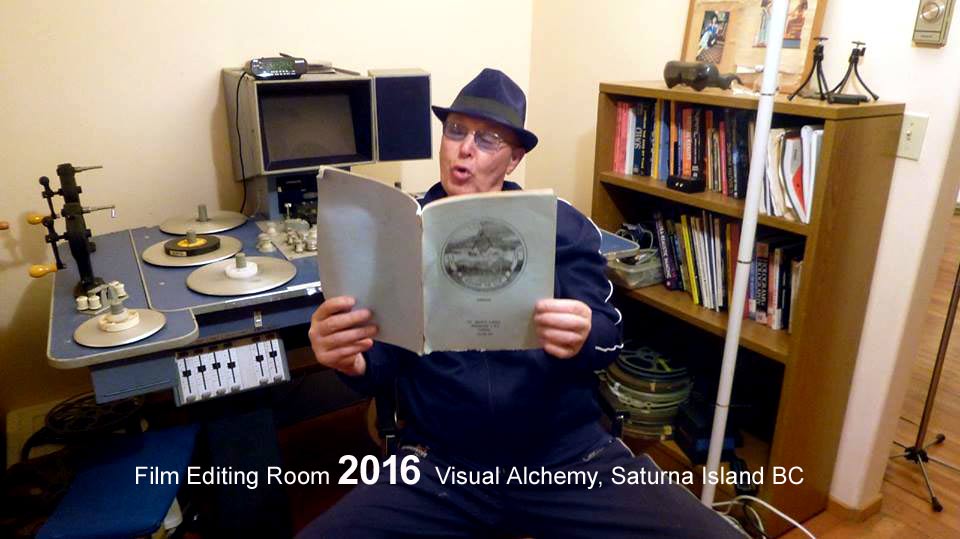
Time Lapse: FILM-RELATED STUDIO & LOCATION PICTURES 1968 - 2016
 <
<

MOTION-PICTURE FILMs BY AL RAZUTIS
All listed works produced and directed by Al Razutis. These are independent creations with credit to concept, writing, cinematography, editing, sound recording and mix, optical special effects, and lab timing by Al Razutis, unless otherwise noted in credits. 'Film by' means precisely that.
See also legacy Optical Printer developed for these projects.
Originals and printing elements stored at Academy Archives, Hollywood, Calif.

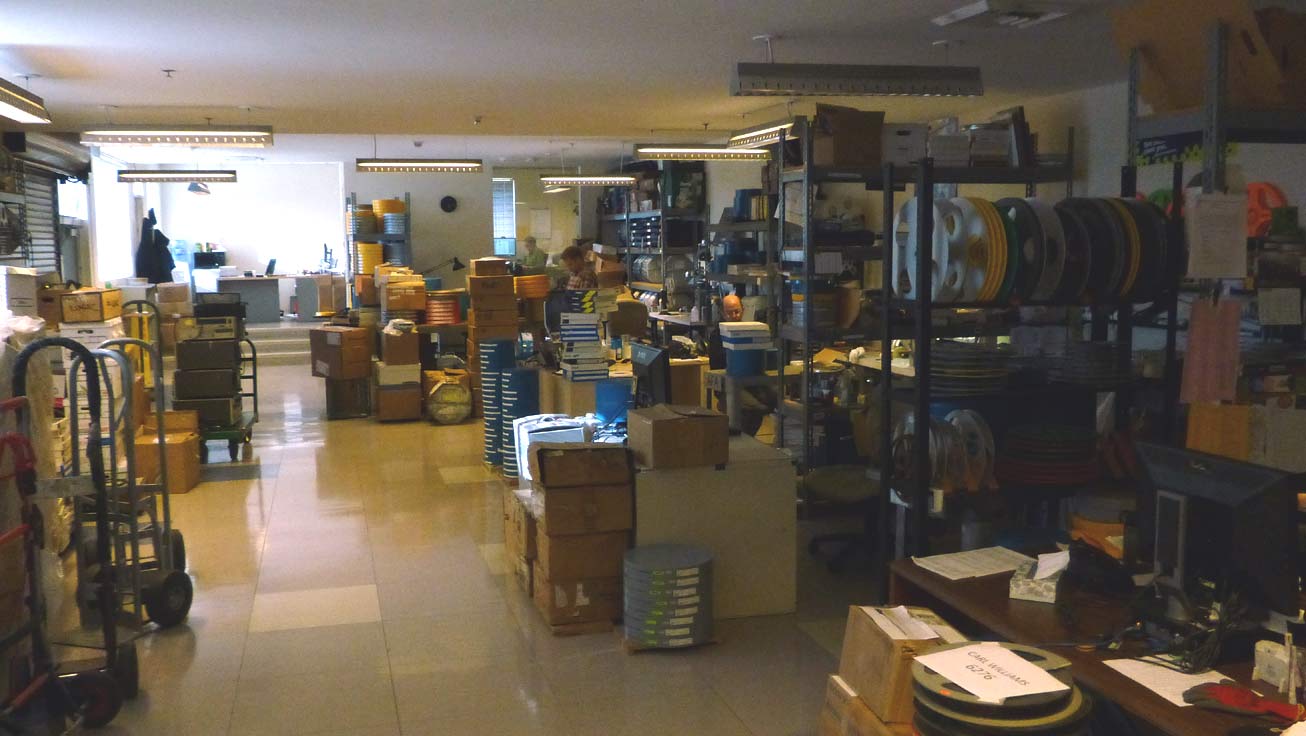
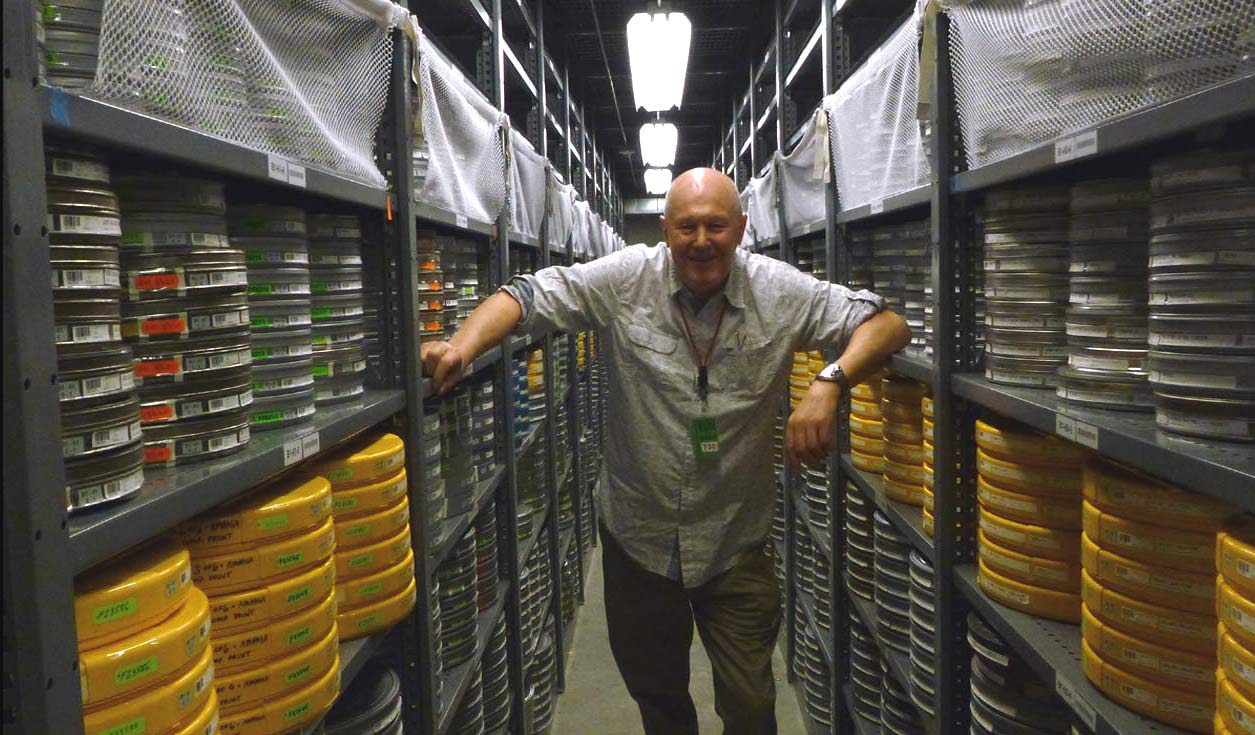
Pictured
in 2013: Mark Toscano, archivist and preservationist
and film-maker Al Razutis
MOTION PICTURE FILM LIST
'2 x 2'
17 min. color sound 1967-68 - two screen film - Al Razutis prod./dir
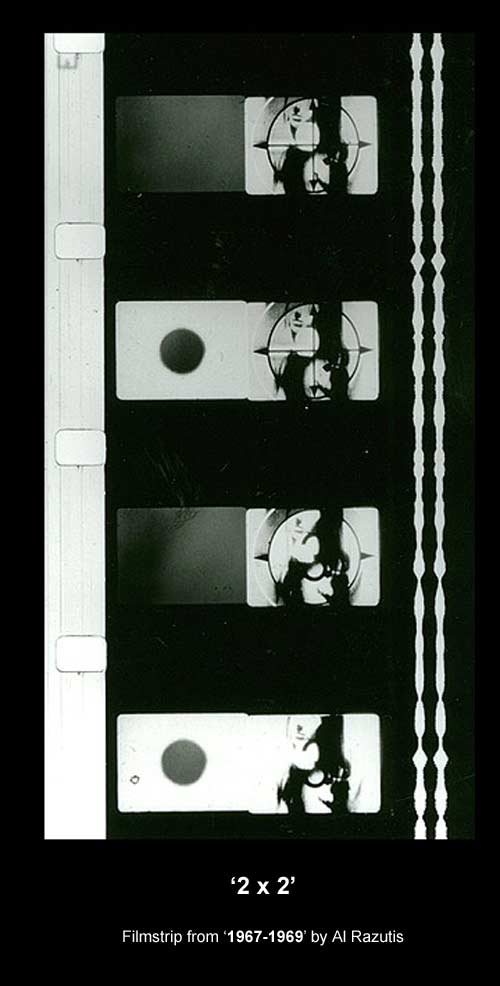
A film on two simultaneous (side by side) screens containing a meditation on abandoned houses, psychedellic 60's, anti-war sentiments, with a 'dystopian' view of society. Filmed in Davis, California, and assembled as 'originals only' for it's first public presentation in a bar (Davis, CA). Subsequently, the originals (film) were sold to Bob Pike, Creative Film Society L.A. to pay for the film-maker's trip to Vancouver, Canada and relocation there. Bob Pike later distributed the film as a A-B roll superimposition (one screen) release print of the two-screen contents with optical sound track. From the Intermedia Film Co-op Catalog (1969): "shooting up on theatered (vegetable) war, people, history, and pure color sound -- transferse journey sustaining elecronic roars that fill mind and body straining to release"(A.R.) Starring: Anelina Calero, John Aden, Kathy Pineo, Henry Chilko. Music from Velvet Underground and Chambers Brothers. Sound recording: Richard Anderson. Editing assistance: Kathy Razutis. Previous distribution: Creative Film Society, Los Angeles. In the collection of Creative Film Society / UCLA Film Archives, Los Angeles |
'Mothlight Sound'
3 min. color silent 1967 - super 8mm film - Al Razutis prod./dir

This film is lost, but the search continues. Previous distribution: Intermedia Film Co-op, Vancouver. Intermedia Film Co-op Catalog listing 1969 text |
'Inauguration'
17 min. color sound 1968 - Al Razutis prod./dir
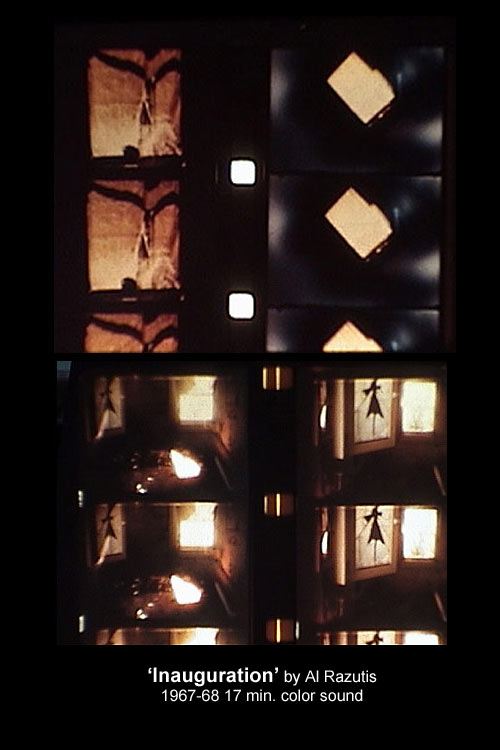
A film with two superimposed screens (from A-B dual-screen film '2 x 2' by Al Razutis - see above) containing a meditation on abandoned houses, psychedellic 60's, anti-war sentiments, with a 'dystopian' view of society. Filmed in Davis, California 1967, with additional footage filmed in Vancouver 1968, and assembled as a new work for presentations/distribution in Vancouver, Canada. Containing original sound track elements from '2 x 2'. Starring: Anelina Calero, John Aden, Kathy Pineo, Henry Chilko. Music from Velvet Underground and Chambers Brothers. Sound recording: Richard Anderson. Editing assistance: Kathy Razutis. Previous distribution: Intermedia Film Co-op, Vancouver, and Canyon Cinema Cooperative, San Francisco. In the collection of the film-maker. |
BLACK LEADER FILMS - FILMS USING BLACK LEADER DURATIONS
'Black Angel Flag...Eat'
12 min. color silent 1967-68 - Al Razutis prod./dir
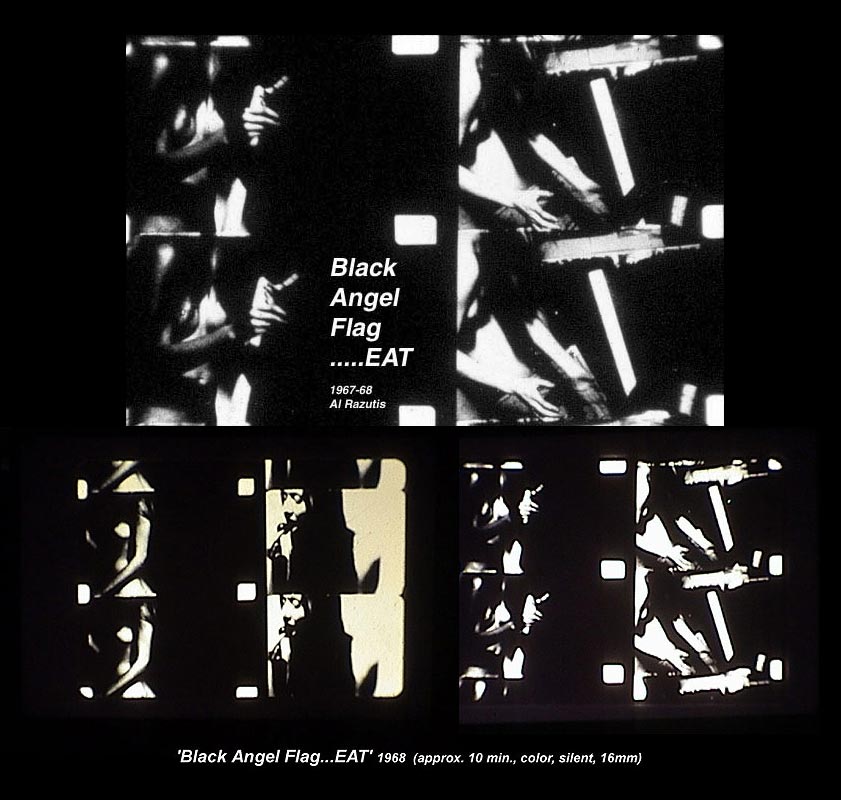
A film comprised of broken up fragments of a nude woman assembling a collapsing structure, and other activities, interrupted by 'black leader' (blank screen) of varying durations, the 'waiting'. The original footage was shot in 1967 (Davis, Calif.) assembled into a film in 1968 (Vancouver, BC). It was screened only once ( a screening that was not received well by the audience or Razutis' friends) in 1968 at Intermedia , Vancouver, and never screened again there. This film was listed for film distribution in the Intermedia Film Catalog 1968. and Canyon Cinema Cooperative, San Francisco (1968-70's). I was described in the film catalogue in the following manner: "showleader to the american flag -- film very dedicated to th android poop spherical flag/ Laura L. eats/ programmed/ @1/2&%$#'!(--/ linear theater bursting/ idolatry of the fem/ made in U.S.A. & the screen films the audience cliced cross-section of america" (A.R. description in the Intermedia Film Co-op Catalog 1969) The intact film or film print is no longer in existence. However, archival original of the all the camera footage minus the black leader sections is in the Academy Archives, Hollywood which also contain most of Razutis' film prints. Previous distribution: Intermedia Film Co-op, Vancouver, and Canyon Cinema Cooperative, San Francisco. Intermedia Film Co-op Catalog listing 1969 text and graphics |
'Poem: Elegy For Rose'
3 min. color sound 1967-68 - Al Razutis prod./dir
|
"A poem written (transversely) on 16mm film with filmed sequence intervals and cacophany of sound. The film 'must be read' on a bench with rewinds, since projection-only (screen projection) delivers only partial content. A 'hands on' film."(A.R.) From the Intermedia Film Co-op Catalog: "filmically; glimpses into the world of a hooker (filmed in s.f. chinatown) and streams of hieroglyph intestinal words -- the poem written transversely across the film -- lines forming words disintegrating ink texture sometimes recognizable and the intrinsic rhythm of strain-thought text: metaphorical poem (which can only be read by TOUCHING the film and READING words on celuloid tape transversely) and it is an elegy for Rose: streetwalker... sound: six layers of electronic music and sound poems (th poem read) amidst eerie insanity of a child's laughter assasinated by lies"(A.R.) This film is lost, but the search continues. Previous distribution: Intermedia Film Co-op, Vancouver . Intermedia Film Co-op Catalog listing 1969 text and graphics |
'SIRCUS SHOW FIRE'
7 min. color sound 1968 - Al Razutis prod./dir

"A day at the circus is rendered with multiple in-camera superimpositions, dissolves, flare-outs (accomplished by opening the film magazine in between shots, or during takes), and a spontaneous sound track. This film captures the childlike rapture of perceiving a circus spectacle as a sensorium of color, images, and sounds." (A.R.) Inspired by Jonas Mekas` film on the same subject. From Intermedia Film Co-op Catalog: "Ectachrome dream of a child's phantasmagoria in light-color-sound free flying trapeze clowns tigerrs elephunks & memorable th bursting...CELEBRATION by fire/light to the sensual eye regenerated & (simultaneous sircus in many dissolves colored ovdrlays a visual celebration barrage -- stoned children & only a circus...)" (A.R.) Previous distribution: Intermedia Film Co-op, Vancouver, and Canyon Cinema Cooperative, San Francisco. Intermedia Film Co-op Catalog listing 1969 text and graphics In the collection of Pacific Cinematheque Pacifique, Vancouver |
'1967 - 1969'
12 min. color sound 1967 - 69 - Al Razutis prod./dir
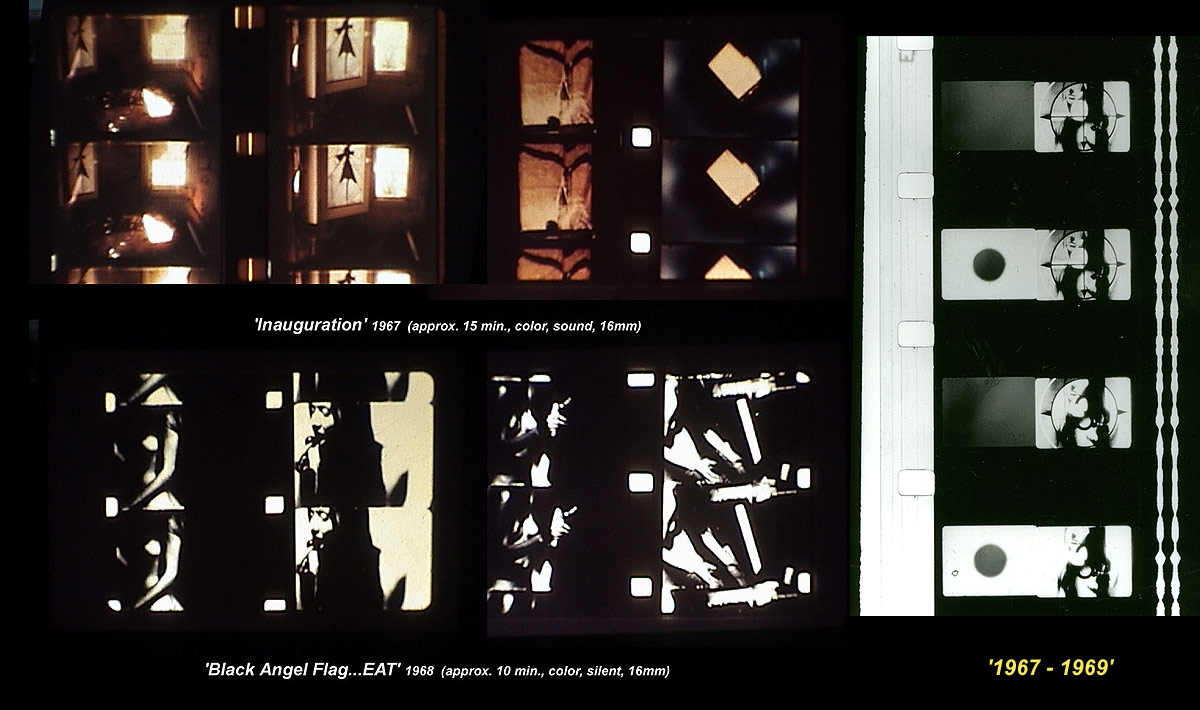
"Two-screen film featuring segments from 'Inauguration' (originally released as '2 X 2') 1967, 'Poem: Elegy for Rose' 1968, 'Black Angel Flag...Eat' 1967-68 by Al Razutis. The tryptich of films was presented in two screen format and featured abandoned dwellings, anti-war themes, sex (and stock porno), drugs, rock and roll (Velvet Underground, Chambers Brothers), write/paint on film, black leader, special effects and 60's collage - montage techniques designed to be 'annoying' yet synaesthetic and critical of our 60`s cultures." (A.R.) '1967-1969' in the collection of Pacific
Cinematheque Pacifique, Vancouver |
BLACK LEADER FILMS - FILMS USING BLACK LEADER DURATIONS
'AAEON'
28 min. color sound 1969-71 - Al Razutis prod./dir
|
90 sec. excerpt video of 2 select sections AAEON |
3 min. excerpt video from AAEON |
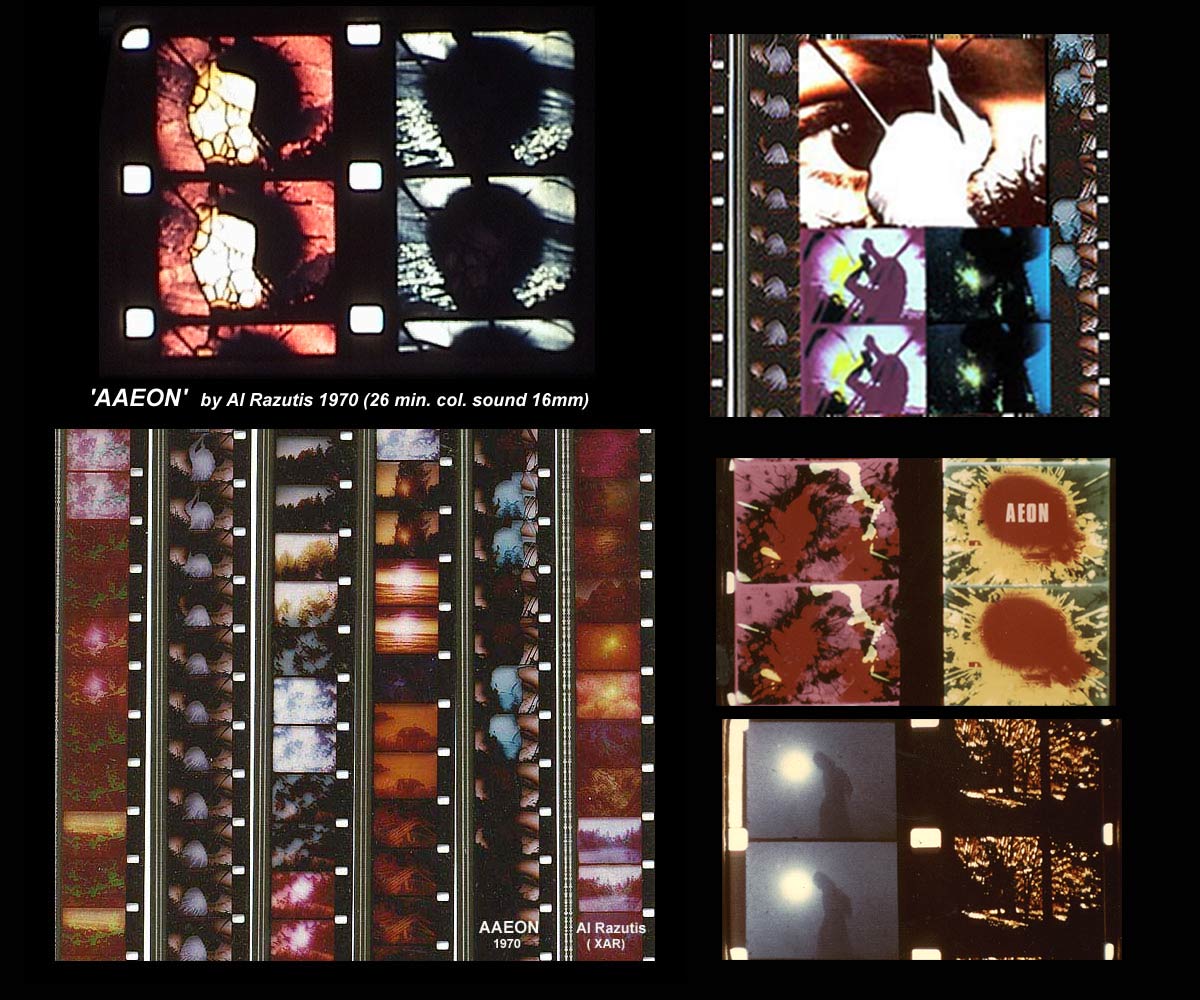
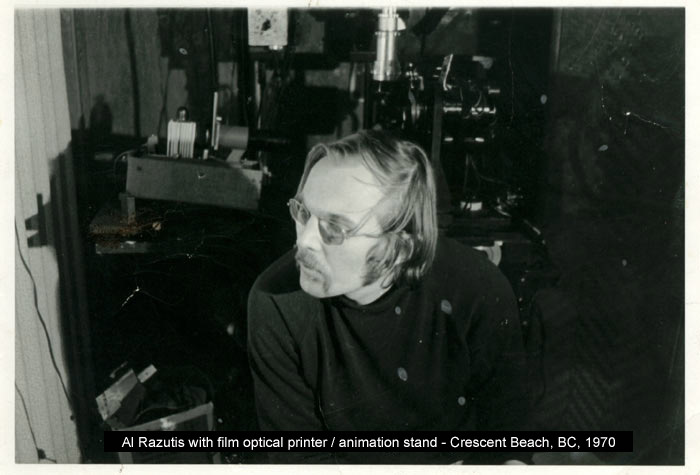
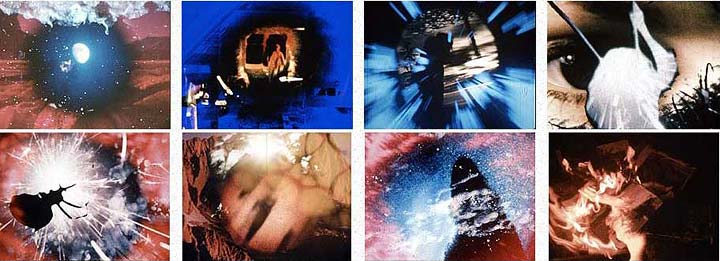
"AAEON is based on experiments with dream recollection - it is a 'dream work' inspired directly by my dreams and the recollection of the vivid imagery and fractured time that would be recalled nightly by purposely waking myself (every hour) and audio recording my recollections of the events. This project required the construction of a film 'machine', the film optical printer, which I built in various stages in 1969-1972 in Crescent Beach and Vancouver." Photo of early version of optical printer by Al Razutis. Also visit >> AAEON FILM PAGE - PICS / TEXTS "The film is composed of four interwoven stages or stanzas that constantly develop and redefine mythological space/time circulating around the ideas of 're-birth' (Tibetan Buddhist ideas, the Tarot, William Blake, oriental and western mysticism were some of the influences at the time) . The film is composed and edited on an optical printer effecting distortions of motion, time, composition, and colour through extensive use of 'layering' (in bi-pack printing, matte printing, step printing, colour separation, burning the film in a projection gate, infrared photography)." (A.R.) The film was a 'hands on' project, created in the spirit of Underground and Experimental authorship where all aspects of film production (producing, directing, cinematography, editing, lab timing, original conforming-neg cutting) were created by individual filmmakers (designating 'a film by') and not by hired technicians, as in VFX department. Original music composed and performed by Phillip Werren. The music and imagery were created as a 'synergy' of both elements. Production assistance was also provided by Peter Jones, NFB Vancouver, one of the few individuals at the NFB who took an active interest in supporting underground and experimental films of the 60's-70's. Appearing: Jurgen Hesse, Kathy Razutis, Ed Varney, and Al Razutis. Screened at the Bellevue Film Festival (1970). In the collections of Pacific Cinematheque Pacifique, and National Film Board of Canada, Vancouver. More at >> AAEON FILM PAGE - PICS / TEXTS All remaining release prints are now stored at the Academy Archives in Hollywood, USA.
References:
Photo collage of AAEON frames and film optical printer / animation stand at Crescent Beach 1970, with Razutis making 'AAEON'.
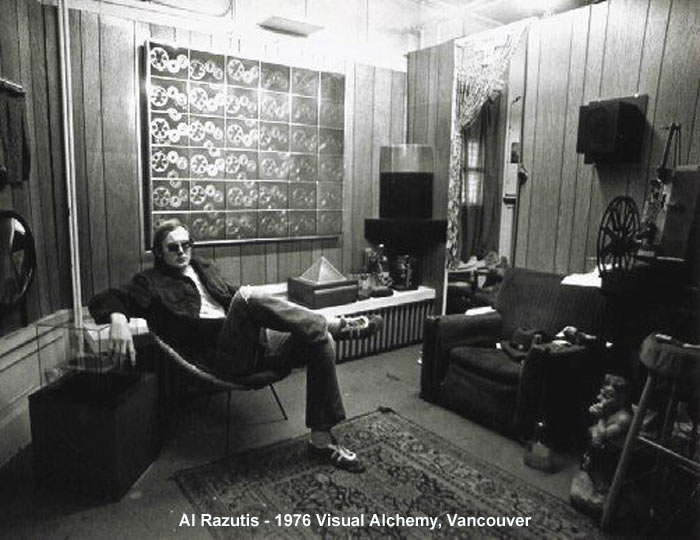
Photo of final film optical printer at Visual Alchemy, Vancouver, 1974.
|
'VISUAL ALCHEMY'
7 min. color sound 1973 - Al Razutis prod./dir.
|
40 sec. excerpt video on YouTube: |
Full 7 min. film on YouTube: |
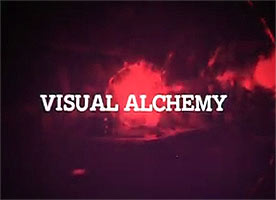
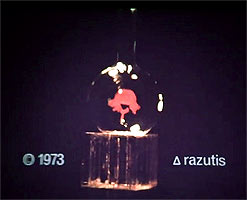
"A poetic document depicting psychological, alchemical, and physical aspects of earlier work in visual "transmutation" at the Visual Alchemy Studio, Vancouver 1973. The work depicted in this film includes early holography at this first art-holography studio in Canada and the projection of real and holographic images in space utilizing lasers and optics."
The sound track uses text fragments from my work and quotes from Carl Jung's Psychology and Alchemy." (A.R.)
Cinematography by Tony Westman, Al Razutis
Videotaped in Canada's first art holography studio, Visual Alchemy, Vancouver, in 1973, with Al Razutis voice-over in a stylized manner invoking the words of Carl Jung on Alchemy.
Re-photographed off screen at The Cinematheque, Vancouver, March 2024 with film curators Sidney Gordon and Felix Rapp in attendance.
'FYREWORKS & WATERCOLOR / ABSTRACT'
4 min. color sound 1973 - Al Razutis prod./dir.
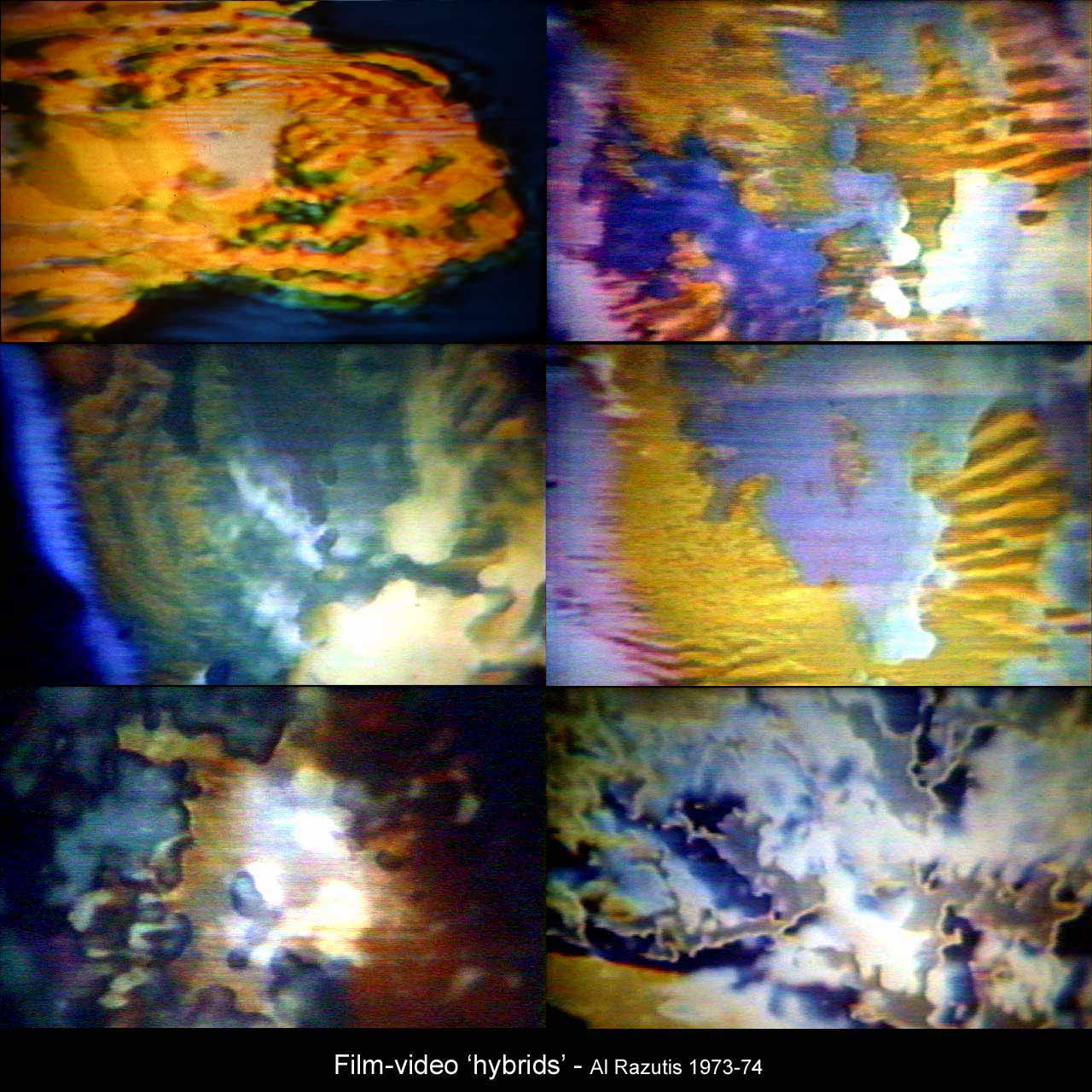
Additional experimetal works proceeding from these hybrids were incorporated in film projected images that I did for the Royal Winnipeg Ballet production of 'What To Do Until the Messiah Comes', Vancouver 1975." (A.R.) Originals film printing elements at the Academy Archives, Hollywood, USA |
'Felix' Video
Synthesizer by Razutis & Armstrong -- Experimental Video studio technology 1970's
'Watercolor/Abstract' Hybrid Video Art essay by Al Razutis on FaceBook
'Synaesthetic Cinema'
The Expanded Cinema of the 1970's
BLACK LEADER FILMS - FILMS USING BLACK LEADER DURATIONS
THE MOON AT EVERNIGHT... 9 min. color sound 1973 - Al Razutis prod./dir.
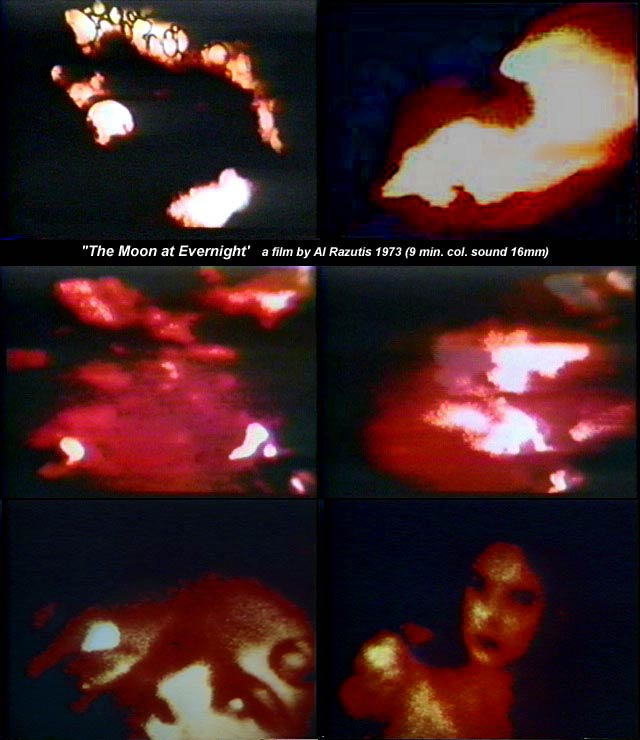
This short film-video hybrid (film / video / film) is comprised of image cycles and haunting sound passages, each cycled preceeded by a wolf's howl in the music track. Like lava pouring into the screen, the optically printed and video synthesized then re-printed frames glow with content almost at the threshold of figurative recognition. As each cycle repeats in variation of image and motion, the "riders in the night" become rescued in our eyes from ghost like patterns. An experimental film 'soundscape video' from 1973 and optical printing / analog videosynthesizer era. The 'band' plays in the mind. "Built on the subliminal manipulation of forms and motion, this film's elusive, fiery images flare up and die back into the night void in recurring cycles, like the fixed but fragmentary elements of some forgotten myth or spell. Violent lyricism and lycanthropy - an optically printed spatial/temporal examination of a violent B-grade adventure film with horror-film sound elements. This series of image cycles abstracts and deconstructs the linear (melodramatic) narrative of television." (A.R. catalog entry) |
All remaining release prints are now stored at the Academy Archives in Hollywood, USA.
BLACK LEADER FILMS - FILMS USING BLACK LEADER DURATIONS
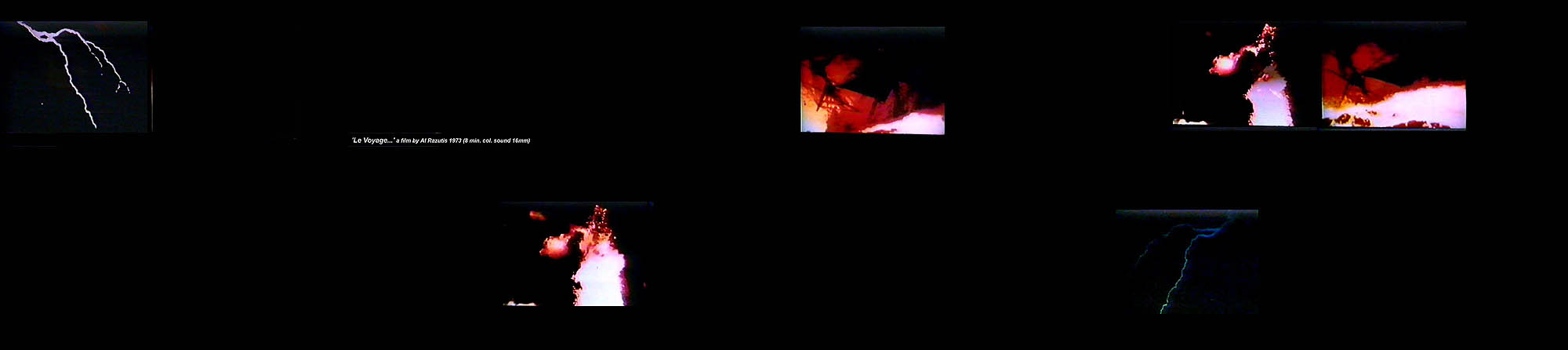
LE VOYAGE...8 min. color sound 1973 - Al Razutis prod./dir. 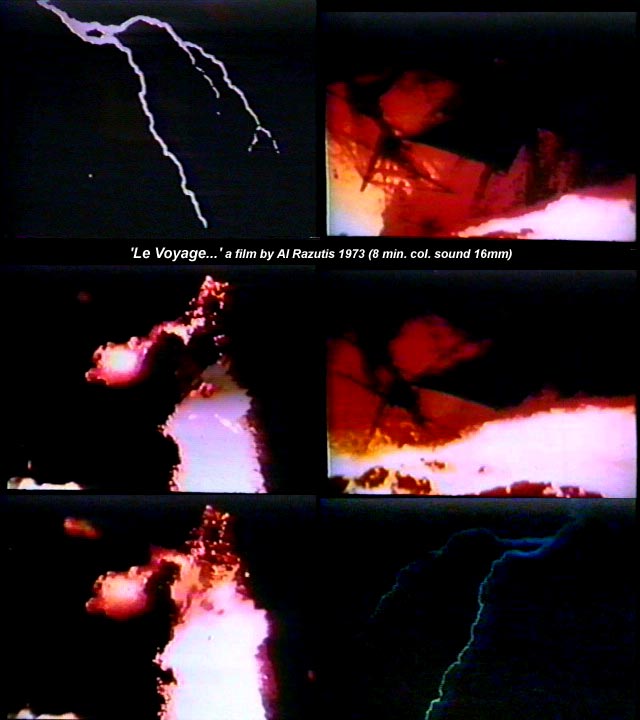
This minimalist narrative film features extensive uses of 'pauses', or black-leader segments, suddenly interupted by image and sound sequences. (See 'Black Angel Flag...EAT' 1968 for comparison in image - pause structures.) The repeating sequences of a 'sailing ship in a storm', lightning, and a lighthouse tower collapsing, become the basis of this punctuated narrative of image and sound. As with 'The Moon at Evernight' (above), this film is a experimental 'music-sound video' from the era of optical printing and analog video synthesis. "A rich visual elaboration, through optical printing, of an archetypal realm characterized by the opposition/interplay of consciousness and matter in discontinuous time. The central image is of a ghost-ship in a storm, and the entire film contains only four basic images. It is composed of "Le Voyage" (the visual 'passage') and "et, les Elements" (the afterimages/aftershock). In homage to Méliès." (A.R. catalog entry) |
All remaining release prints are now stored at the Academy Archives in Hollywood, USA.
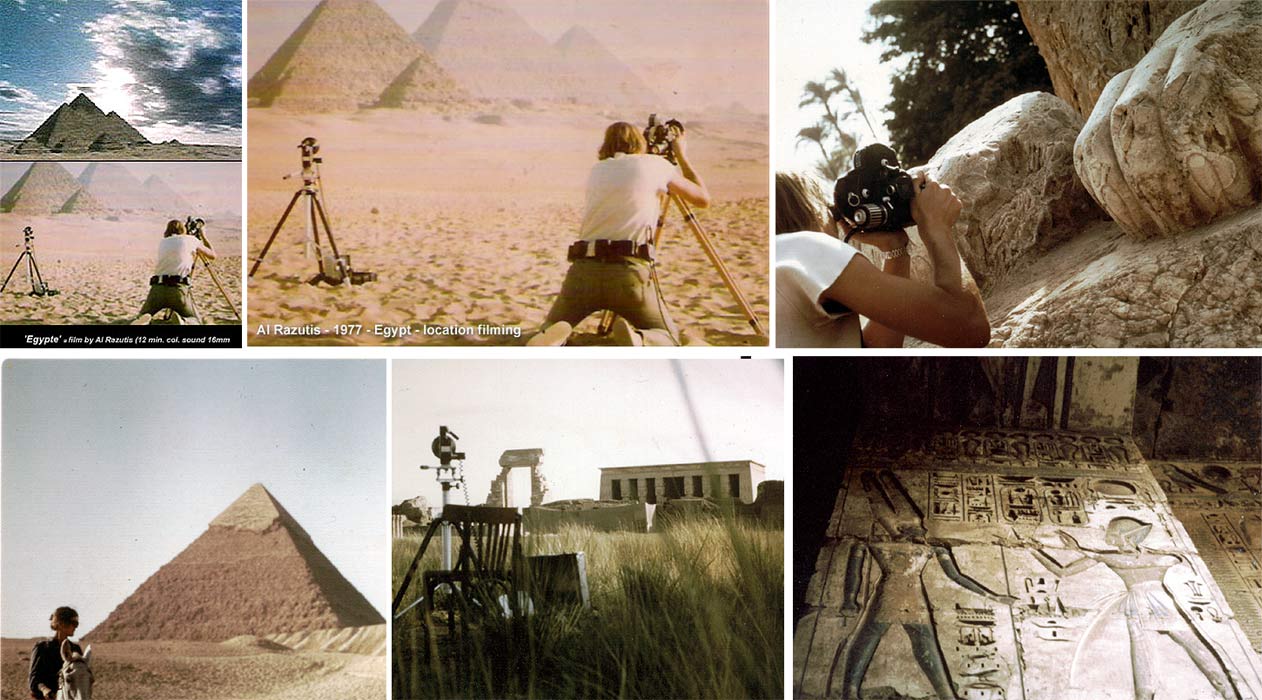
ÉGYPTE12 min., 1976-7 - Al Razutis dir.
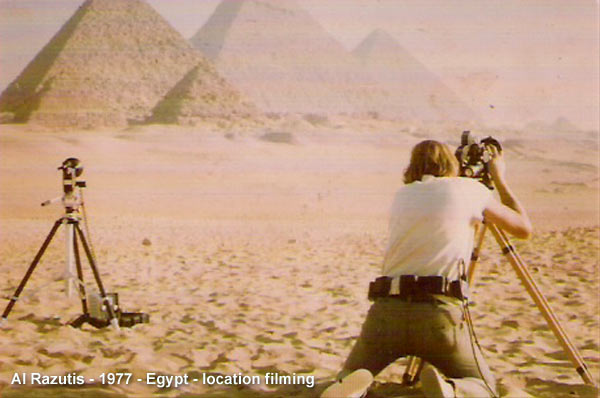
ÉGYPTE is a meditation on ancient time and space. Inspired by the Tibetan Tantric chants of the Lamas (which also comprises the sound track), this impressionistic piece presents the ancient sense of 'mystery' without recourse to narration or didactic (historical) interpretation. The film features extensive use of time-lapse cinematography, and close-up tracking shots of hieroglyphic walls and temples, ranging in location from the Giza pyramids to the Luxor temples, and other notable locations in Egypt. The film 'poem' takes the viewer to the place of 'the ancients'. Later films utilizing similar subjects/styles, though in 70mm and using world-wide locations, include Baraka by Ron Fricke. Produced for the National Film Board of Canada, Executive Producer Peter Jones, Producer Don Worobey. Written, Directed, Cinemematography, Editing, Sound Editing-Audio Recording & Mixing by Al Razutis Research, Location & Production Assistance by Catharine MacTavish (A film by a two person production crew over 900 miles of Nile locations.) In the collection of the National Film Board of Canada Additional Film-maker's note: This film represents one of several themes filmed in Egypt by the filmmaker (Razutis) as assisted by Catharine MacTavish. A falling out with a new Executive Producer (John Taylor) over Razutis' insistence to exclusively edit and mix the film in post-production resulted in the remaining 3 films (as Razutis planned) to be abandoned, and the remaining footage was sold by the NFB as 'stock footage' to be featured in various documentaries on PBS (Public Broadcasting - US) documentaries on Egypt. 'That's life, when you're not a producer.' A.R. |
PORTRAIT
9 min. color silent 1978 - Al Razutis prod./dir.

The use of extreme iage magnification and hi-contrast color processing results in a pointillist style of film as 'painting in time'. The sequences feature 'flare out' transitions also reminiscent of Razutis' earlier 'Sircus Show Fyre' (1968). Recently re-discovered release print stored at the Academy Archives in Hollywood, USA.
|
'EXCERPT FROM MS: THE BEAST'
|
28 min. color sound, 1971-81 - Al Razutis
prod./dir
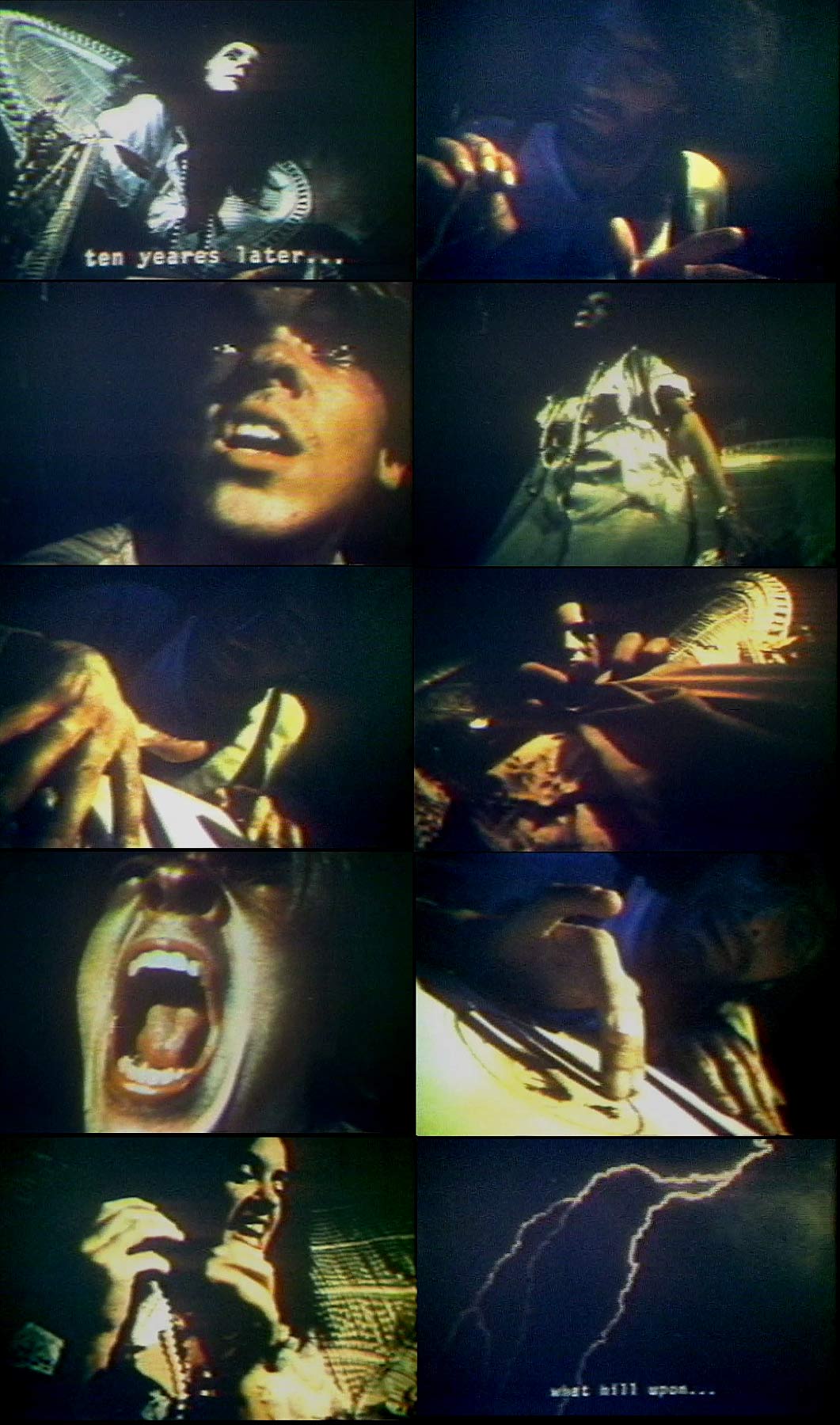
A complex experimental narrative based on an original screenplay by Al Razutis. The poetic language spoken by the characters Jack and Jill, a language loosely related to the forms of Finnegans Wake and Shakespeare features puns and turns of phrases amidst a bizarre Victorian setting. "The poetic language follows a dream vision of interpersonal and familial catastrophe that is eternally recurring amongst these archtypal characters, and their dwarf offspring. The film makes extensive use of distorting lenses and optical printing, sound overlays, to restructure the narrative, a `dreamspeak' narrative of sorts ...myth making and myth mocking. The point of view of the written and spoken language is modelled after that of childhood: listening, registering, and attempting to comprehend the language of parents. The parents, in this case, are also my literary predecessors." (A.R.) This film was originally funded by the Canadian Film Development Corporation (a precursor to Telefilm Canada), but a falling out between the director and executive producer (of Telefilm) resulted in the completion being delayed 10 years and completion funding arranged separately by the director (Razutis). Cinematography by Tony Westman 'THE BEAST': Original Novel & Screenplay by Al Razutis - Excerpts |
All remaining release prints are now stored at the Academy Archives in Hollywood, USA.
'ON THE PROBLEM OF THE AUTONOMY OF ART IN BOURGEOIS SOCIETY, or... SPLICE'
23 min. color sound 1986 Prod/dir by Al Razutis / Scott Haynes / Doug Chomyn|
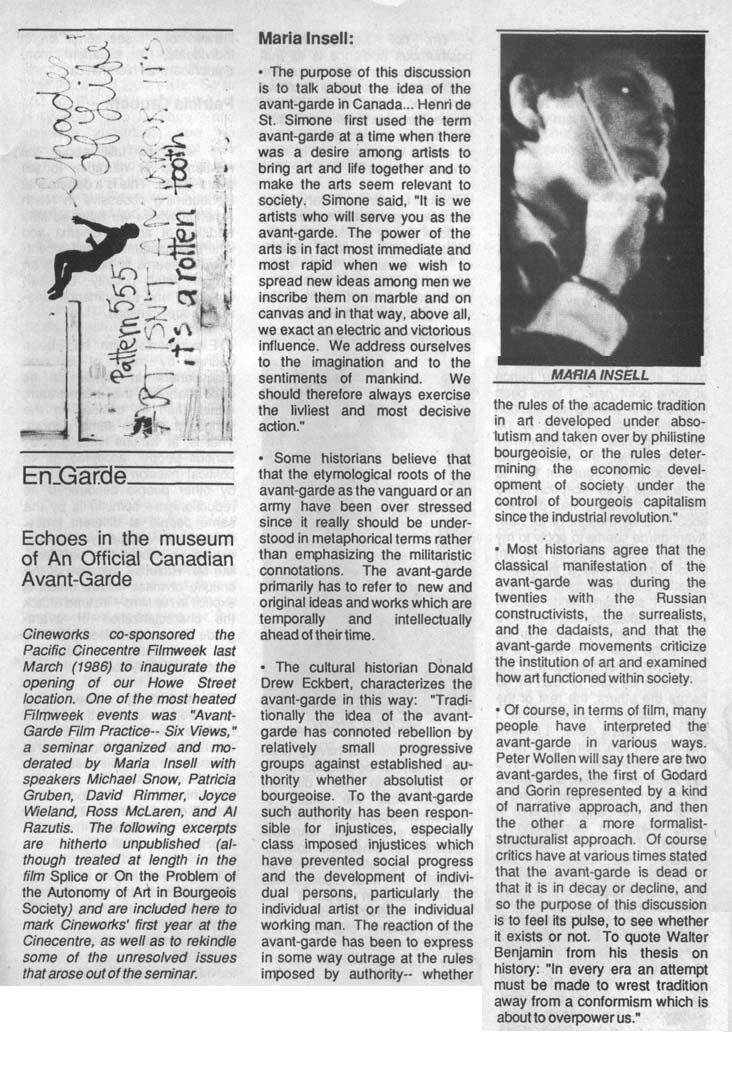
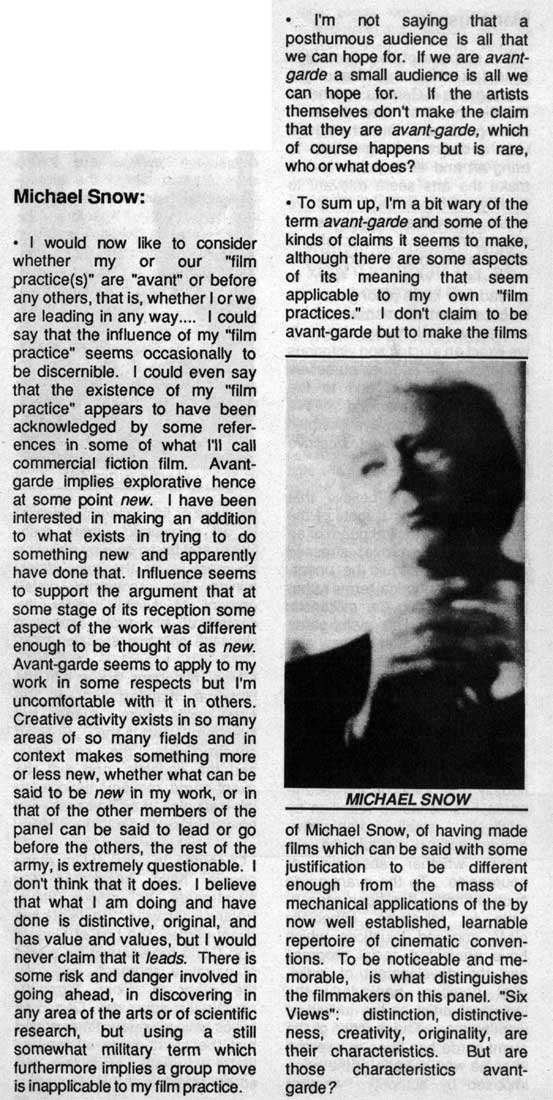
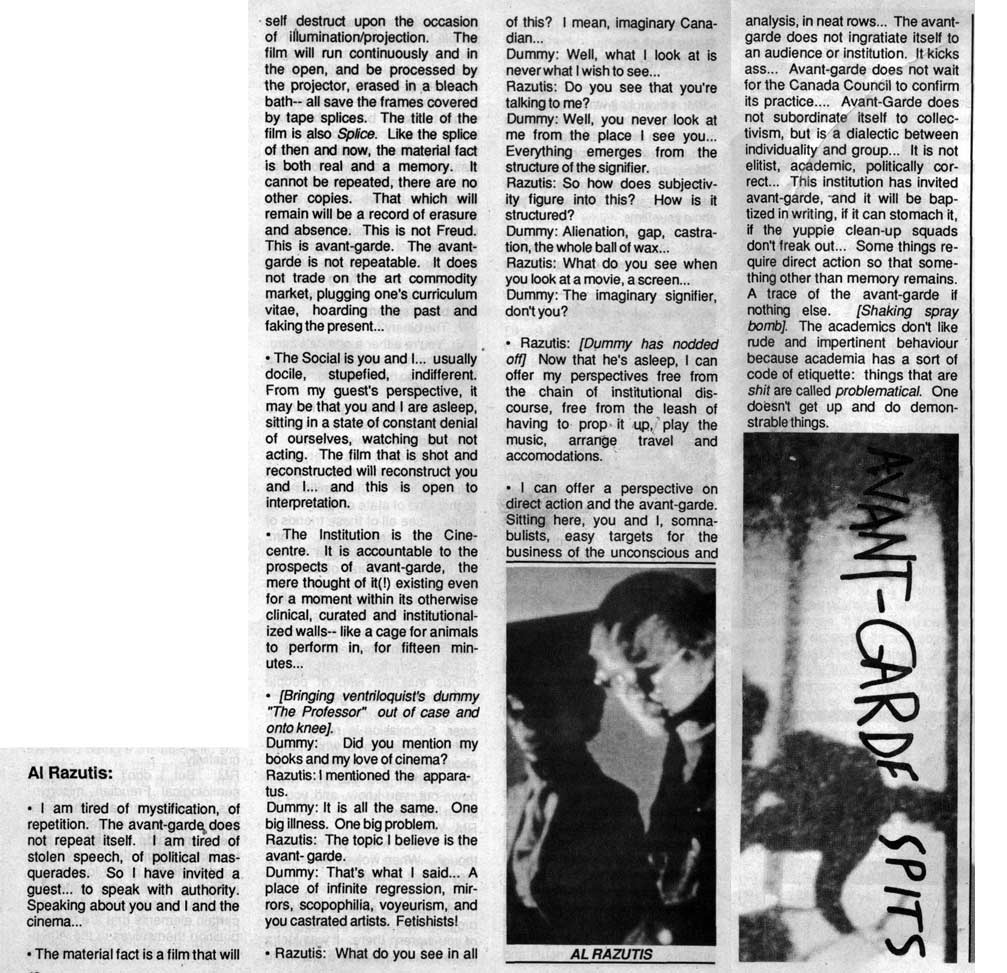
In March 1986 in Vancouver, as part of National Film Week and the opening week events for the new Pacific Cine Centre, a panel presentation on "Avant-Garde Film Practice," moderated by Maria Insell, was held in front of a cinephile audience. "This film is a reconstruction, reinterpretation, and representation of this event, featuring five of the panelists offering views on 'individualism' (MICHAEL SNOW), 'new feminist narrative' (PATRICIA GRUBEN), 'erotic aestheticism' (DAVID RIMMER), and 'anti-semiotics' (JOYCE WIELAND and ROSS McLAREN). Their presentations are reconstructed using formal devices that arise in their particular film practices. Texts of film-maker panel presentations
- published in SPEED Spring 1987
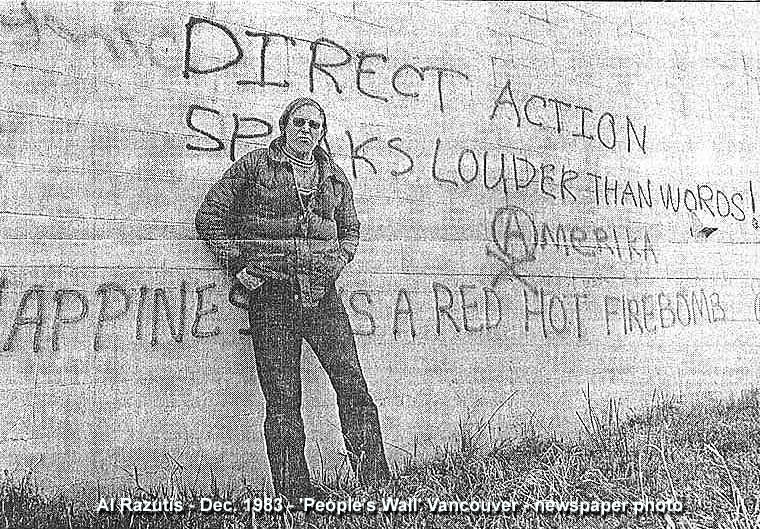
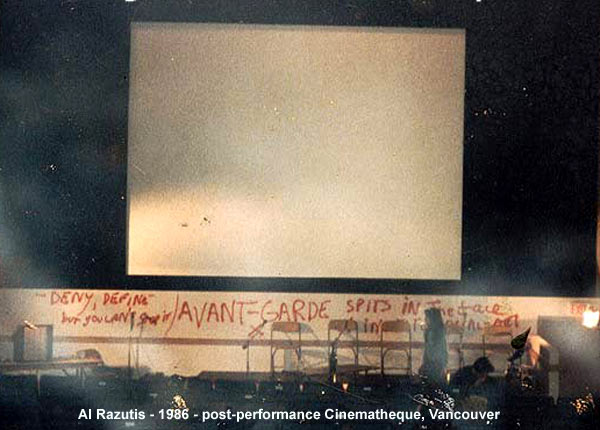
Prior to the pro-filmic event, Al Razutis asked Maria Insell, the organizer of the event, to be placed 'last' in order of presentation The second half of the film ( 'SPLICE' ) is devoted to the film-destruction screening / performance / "direct action" conducted by AL RAZUTIS, which was titled 'SPLICE', in reference to the film projection 'spliced' to the simultanous performance in front of projection screen with dummy by Razutis. (Razutis admits to 'turning on the projector' as well as carrying a replica gun in the dummy's suitcase.)
'The academic, the projectionist and the walkabout artist' This film re-creation contains traces of the original film, which was destroyed (except for splices) in the projector bleach bath as it was projected. It also presents fragments of Razutis' performance with a ventriloquist's dummy (the Lacanian "subject of semiotics"), and his concluding graffiti sprayed on the front wall of the Cine Centre theatre. As an intervention against film orthodoxy and film theory (of the time) conceits, this film encapsulates within its production methods the 'praxis' of avant-garde responses to art, culture, and politics. A re-deconstruction document of the various 'interpretations' of 'What is Avant-Garde Cinema?" (A.R.) Film Credits: Collaborative work by Al Razutis, Scott
Haynes, Doug Chomyn, More on SPLICE.. and AMERIKA
Between Agonism and the Autonomy of Art: The Case of Al Razutis' by
William C. Wees |


All original printing elements and remaining release prints are now stored at the Academy Archives in Hollywood, USA.
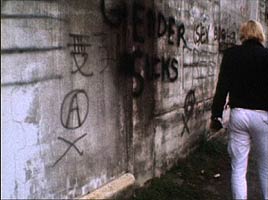
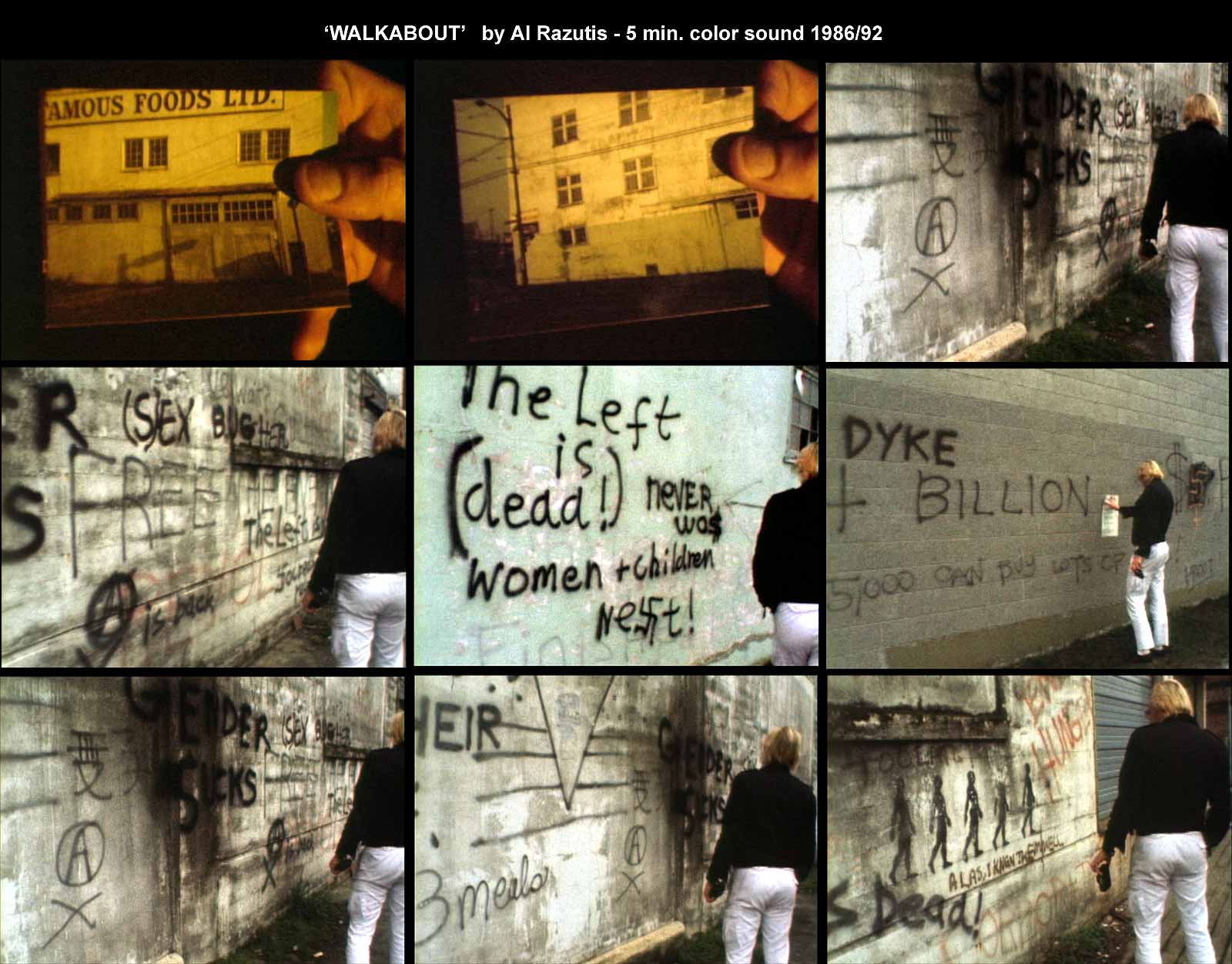
'WALKABOUT'
5 min. color sound 1986/92 Prod/dir by Al Razutis
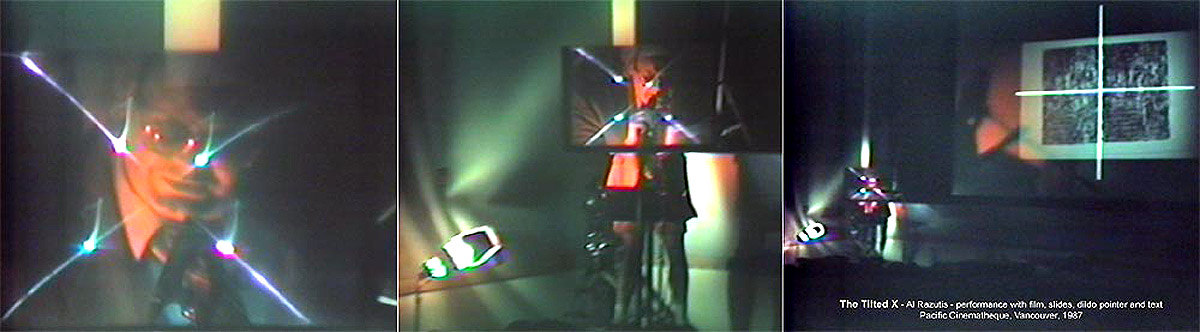
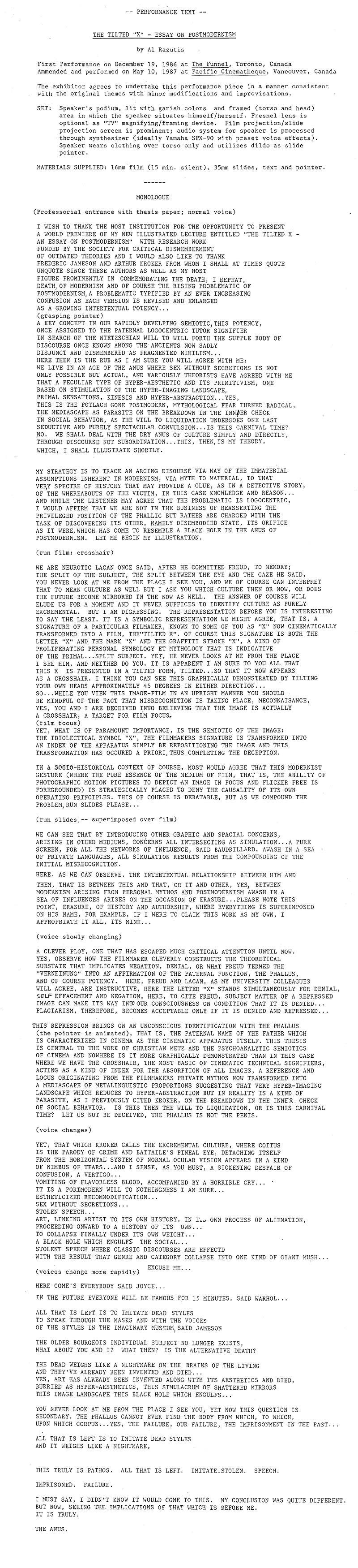
'THE TILTED X'
15 min. B&W silent 1986 prod/dir by Al Razutis - performance with film/slides/voice-synthesizer and set/props
|
|
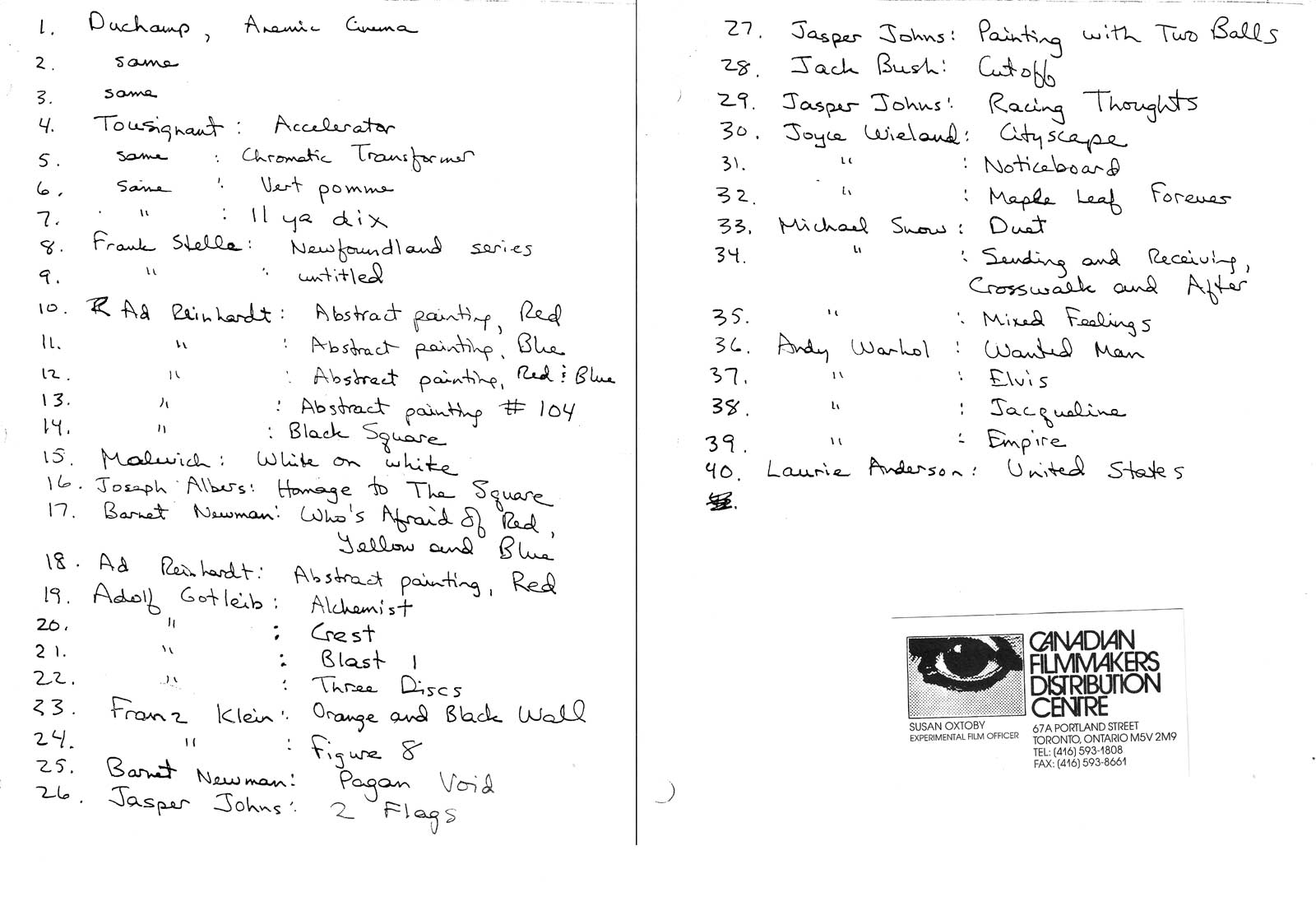
Wearing a professorial suit (without pants), poised at a podium (with magnifying screen), Professor Al Razutis proceeds to "instruct" with the pointer, read from the text (writings based on Frederick Jameson, Arthur Kroker, Deleuze, Benjamin and others) while a series of slides were projected with superimposed projected 16mm film cross-hair - the tilted X. The film-performance by Razutis of The Tilted X - Essay on Postmodernism was featured at The Funnel, Toronto, Ontario (December 19, 1986), and the Pacific Cinematheque, Vancouver, B.C. ( May 10, 1987), shortly after his resignation and shortly before departure from Simon Fraser University (September, 1987).
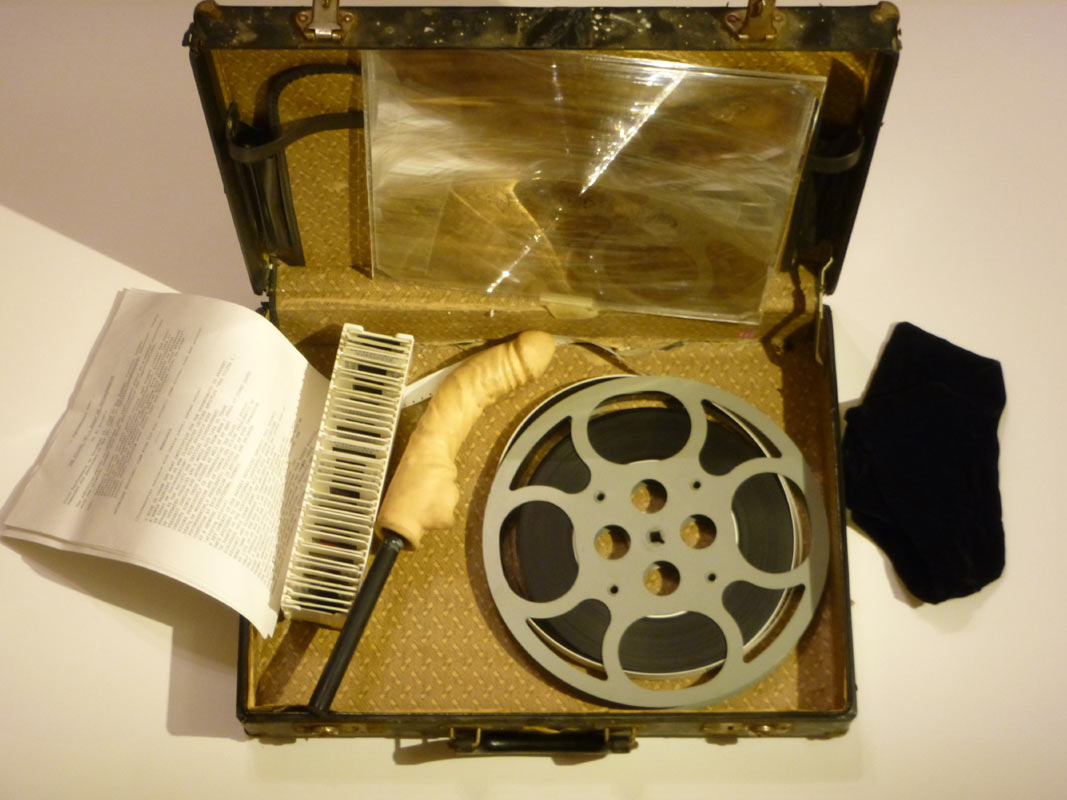
Note: This PERFORMANCE KIT features all of the elements from the performance piece, with the undertaking for the user to perform the piece. |

More on avant-garde practice '
Between Agonism and the Autonomy of Art: The Case of Al Razutis' by
William C. Wees
(Originally published in The Cantrills Filmnotes, 1989) - HTML
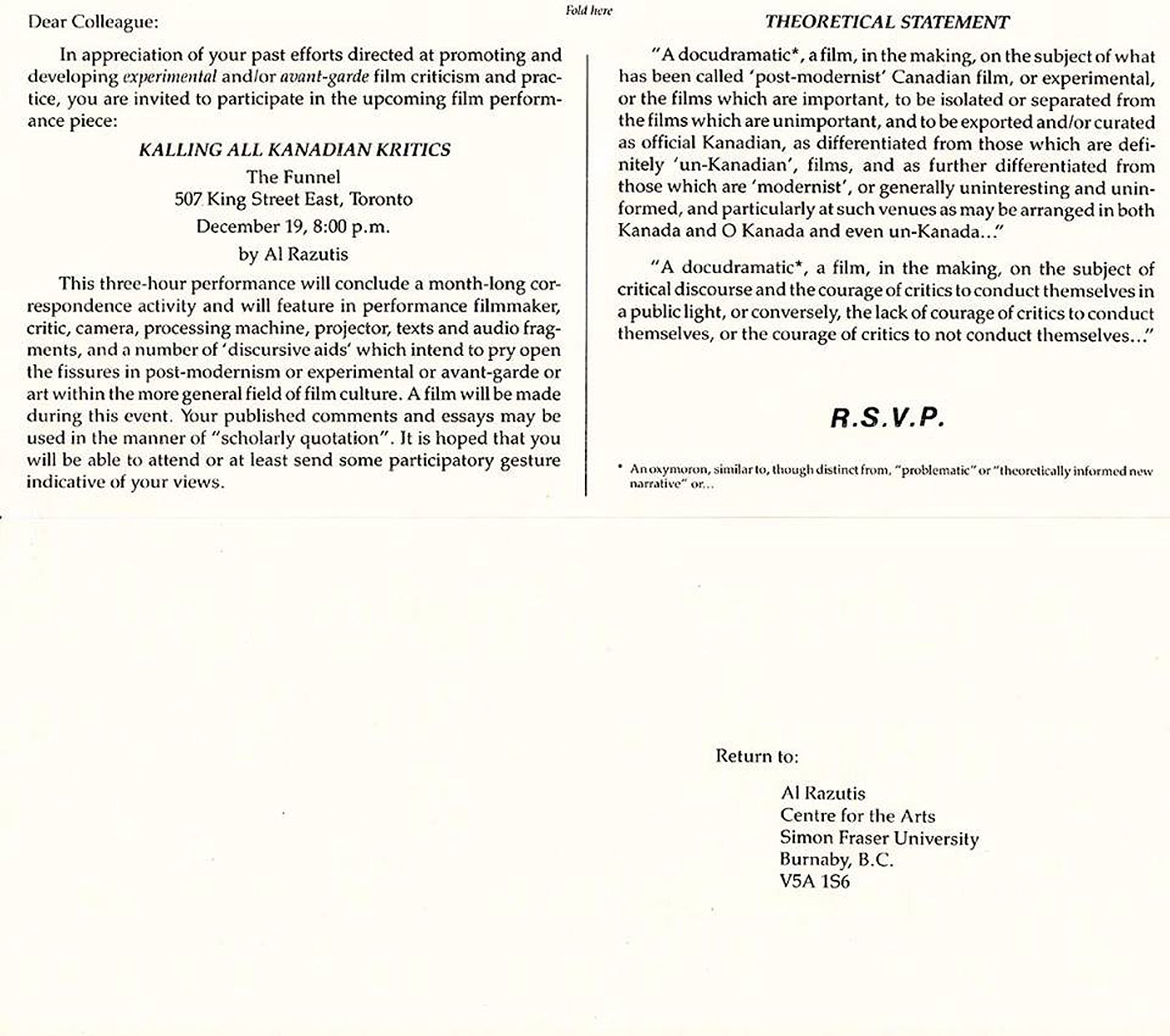
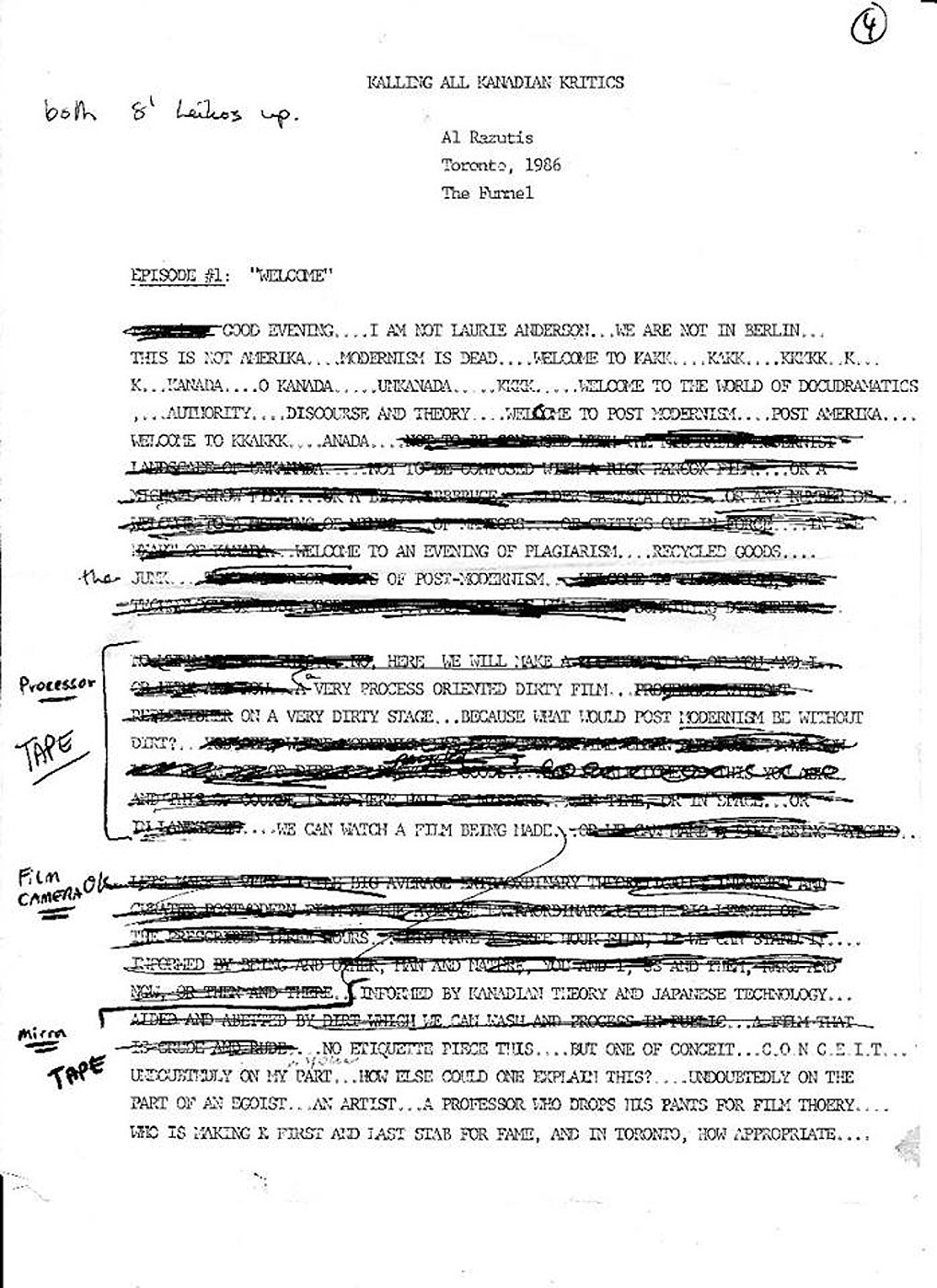
'KALLING ALL KANADIAN KRITICS'
1986 prod/dir by Al Razutis
performance with 16 mm film strips, overhead projector, various props
|
|
|
|
|
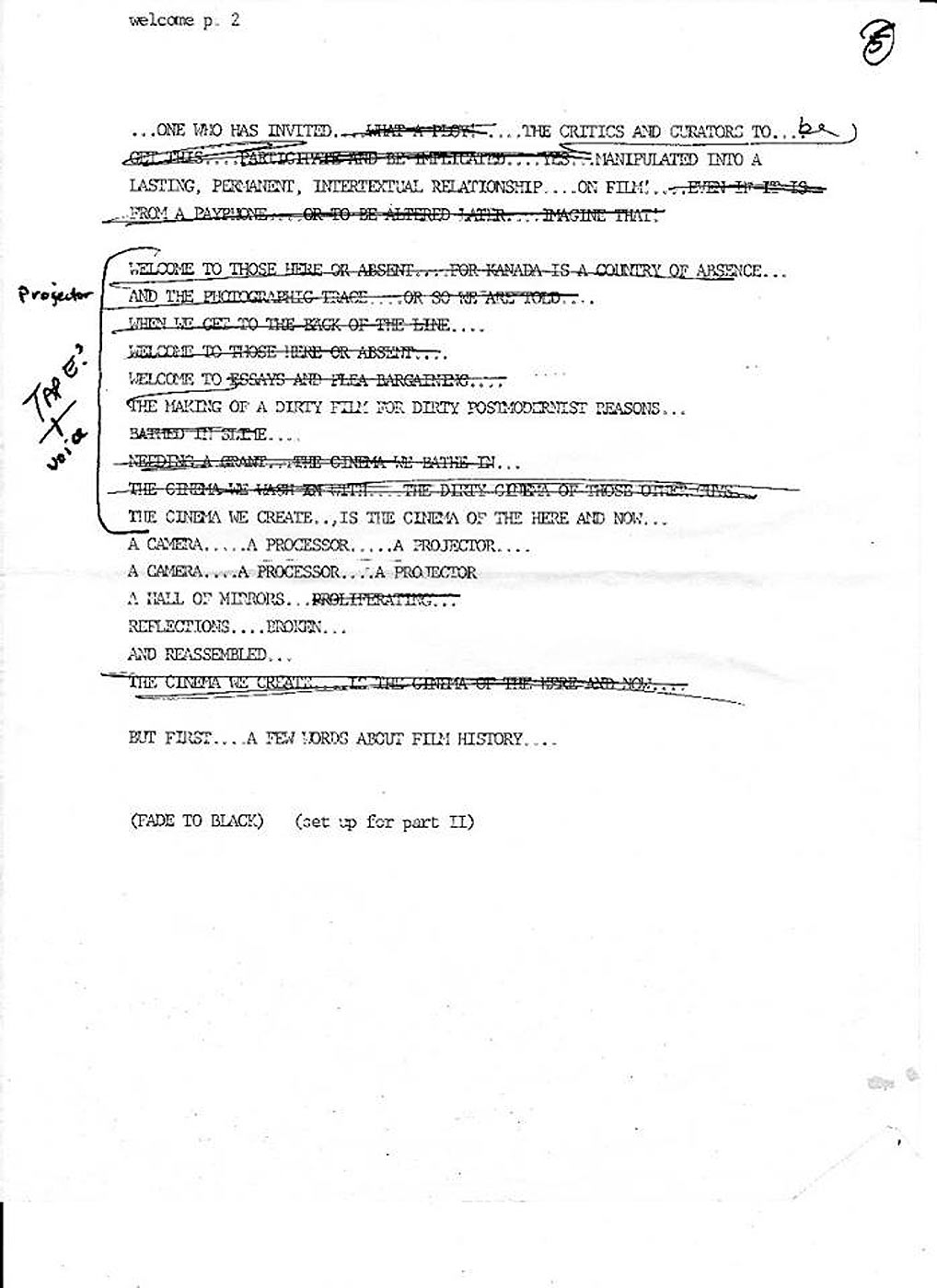
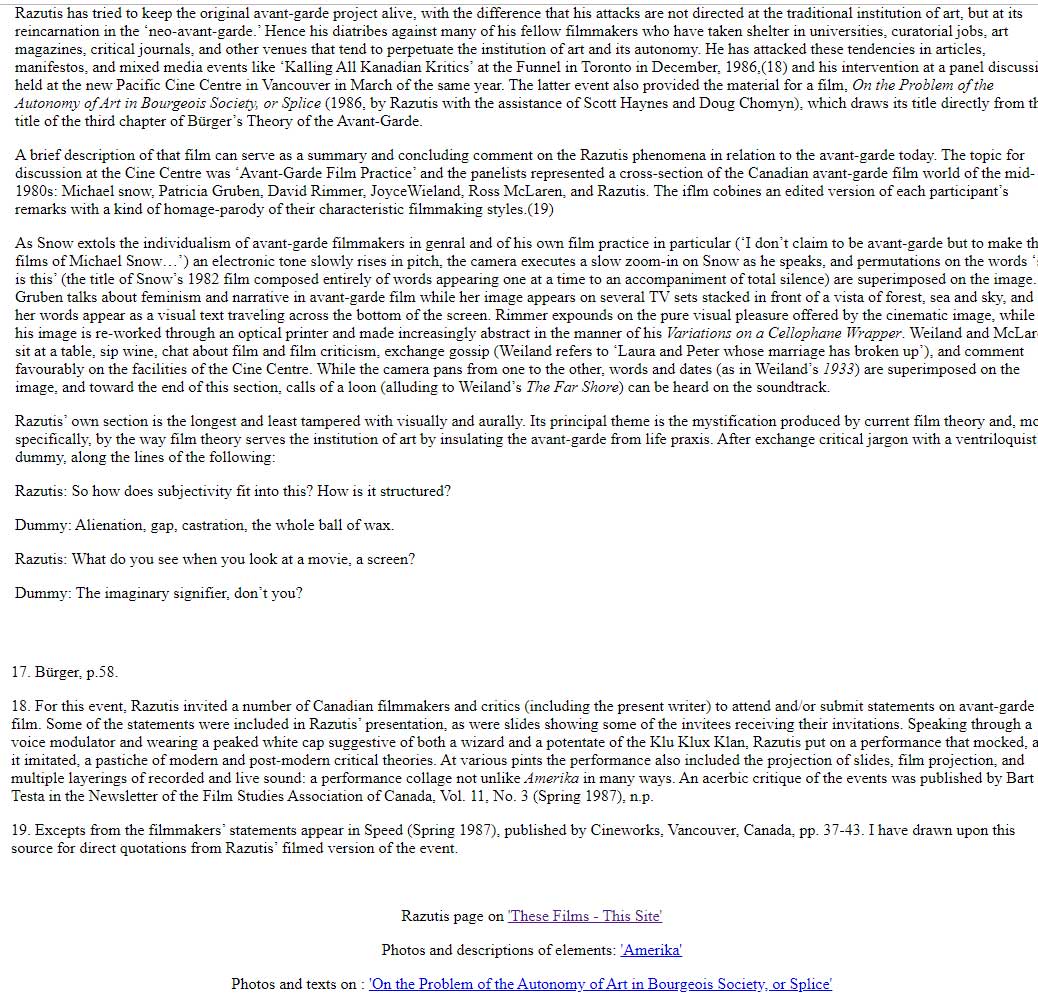
What the critics said (>William C. Wees - footnote 18): "For this event, Razutis invited a number of Canadian filmmakers and critics (including the present writer) to attend and/or submit statements on avant-garde film. Some of the statements were included in Razutis' presentation, as were slides showing some of the invitees receiving their invitations. Speaking through a voice modulator and wearing a peaked white cap suggestive of both a wizard and a potentate of the Klu Klux Klan, Razutis put on a performance that mocked, as it imitated, a pastiche of modern and post-modern critical theories. At various pints the performance also included the projection of slides, film projection, and multiple layerings of recorded and live sound: a performance collage not unlike Amerika in many ways. An acerbic critique of the events was published by Bart Testa in the Newsletter of the Film Studies Association of Canada, Vol. 11, No. 3 (Spring 1987), n.p." |
'METALEPSIS' (On Censorship)
35mm film strips 1987 prod/dir by Al Razutis
performance with 35 mm film strips, overhead projector, cigarette lighter
|
|
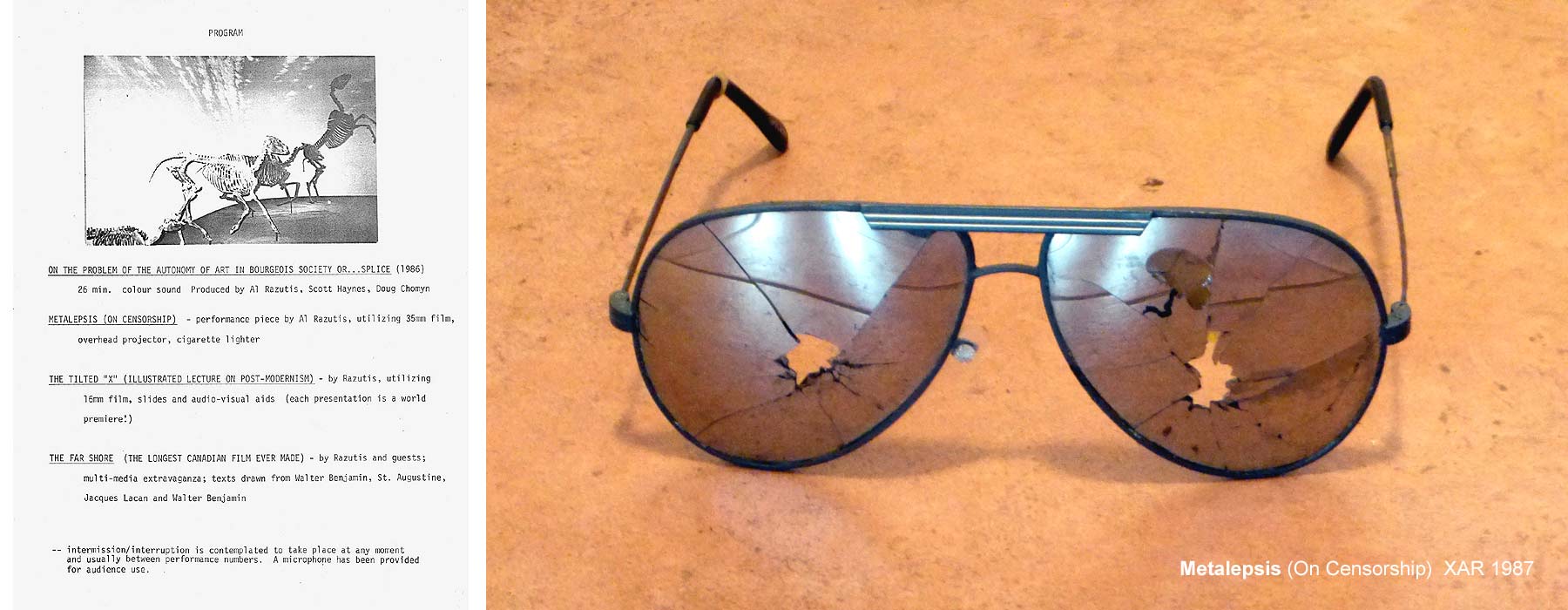
A blind-folded with shattered glasses character is poised at an overhead projector with 35mm film strips and a cigarette lighter. The film-performance by Razutis of Metalepsis (on censorship) was featured at the Pacific Cinematheque, Vancouver, B.C. ( May 10, 1987), shortly after his resignation and before his departure from Simon Fraser University (September, 1987). PERFORMANCE TEXT - METALEPSIS - PDF file |
'THE FAR SHORE'
1987 prod/dir by Al Razutis
Performance with block of ice and audience on the making of Canadian films
|
|
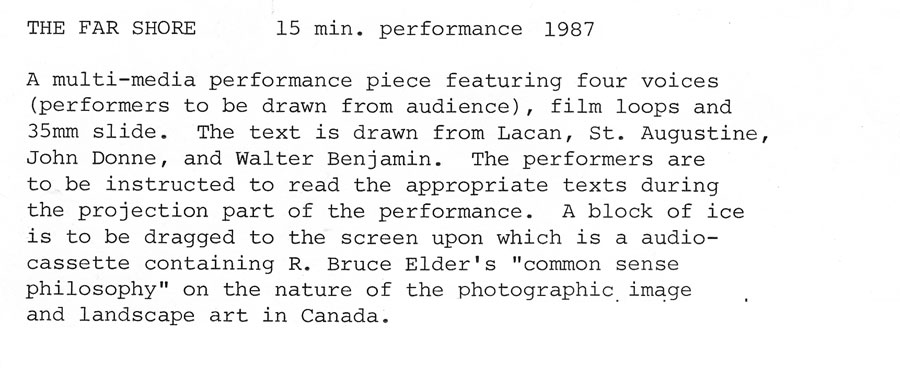
A 'director' with basebal cap encourages audience to participate as time-lapse film camera shoots melting block of ice. The performance by Razutis of The Far Shore was featured at the Pacific Cinematheque, Vancouver, B.C. ( May 10, 1987), shortly after his resignation and before his departure from Simon Fraser University (September, 1987). |
'FINAL FILM PERFORMANCE' (May 10, 1987)
|
|
This film-performance (excluding 'The Far Shore') by Razutis was first performed in 1986 in Toronto at The Funnel, as part of "KALLING ALL KANADIAN KRITICS" and performed in total at the Pacific Cinematheque, Vancouver, B.C. ( May 10, 1987) in a modified form and shortly after his resignation and before his departure from Simon Fraser University (September, 1987). |
'LA JAM'
1989 prod/dir by Al Razutis
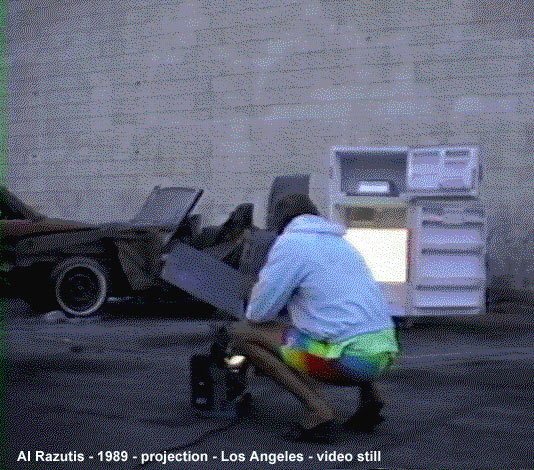
Outdoor installation with projector and refrigerator and basketball hoop

"How do I fit the 405 freeway into a refrigerator and still have space to play some ball?" 'End of Cinema According to Basketball Jones' - 2022 essay including this work by Al Razutis. |
* Avant-Garde Film Catalogue * Current DVD Film - Video Subjects Distributed
VIDEO ART BY AL RAZUTIS
|
All listed works produced and directed by Al Razutis. These are independent creations as video art, exhibited in galleries and other venues, with credit to concept, writing, videography, editing, sound recording and mix, video special effects and rerecording by Al Razutis, unless otherwise noted in credits. 'Video by' means precisely motion-pictures for TV screen authored in video. |
'Felix' Video
Synthesizer by Razutis & Armstrong -- Experimental Video studio technology 1970's
'Watercolor/Abstract' Hybrid Video Art essay by Al Razutis on FaceBook
'Synaesthetic Cinema'
The Expanded Cinema of the 1970's
Audio and bio-feedback origins of videosynthesizers / 'Felix' in performance on Vancouver television
"Waveforms and Synapses"
4 min. on YouTube:
'VIDEOGRAPHICS: SELECTED WORKS' (1972 - 1974)
('Software', 'Vortex', 'Aurora', 'Moon at Evernight', '98.3 KHz: Bridge at Electrical Storm' - 40 min. )

1-2 min. excerpt videos from this work on YouTube:
|
VIDEOGRAPHICS is a collection of film - video 'hybrids' representing the crossing over from film to video (back and forth) image processing - synthesizing techniques that involved both the video-synthesizer (Razutis - Armstrong FELIX) and Razutis' personally built film optical printer. Neither exclusively 'film' nor 'video', these groundbreaking works represented the first Canadian experimental film-videos that challenged the oppressive critical orthodoxies of (what is) 'film' or 'video' art that were rampant in their respective 'scenes' at that time. The individual works contained in this tape are Software/3min., Vortex, Aurora, The Moon at Evernight, and 98.3 KHz: (Bridge at Electrical Storm. Some of the individual works were incorporated in Razutis' avant-garde feature film 'AMERIKA', and were individually screened, awarded and subject of critical essays. Analog video-synthesisis and film optical printing were the precursors to modern-day digital effects which carried the early formal vocabulary into more 'refined' (digital) forms that are commonplace today. All picture, sound, and processing elements contained within these works were created by Al Razutis at Visual Alchemy (1972 - 1974). Previous distribution: Video Out, Vancouver In the collection of the National Gallery of Canada, Ontario College of Art and Design (OCAD), Nova Scotia College of Art and Design (NSCAD)
Collection copies available on DVD |

'HYBRID' (1973)
Co-created with Gary Lee-Nova - 60 min.
|
|
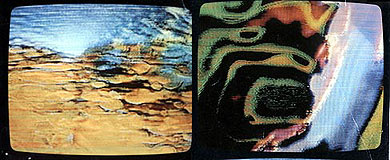
HYBRID is a video featuring some of the earliest experiments (done on 1" tape) in synaesthetic video art and 'hybrid' forms of film and video. It is an assemblage of 16mm film and video content that integrates both film (pre-existing film material by Razutis and Lee-Nova) and video intermediates which re-interpret this material using video synthetic processes (feedback, colorization, quantizing, abstracting). Razutis and Lee-Nova travelled to Evergreen State College, Olympia, Washington and Portland City College in Portland Oregon and engaged their supportive staffs to create this experimental video art piece over a number of months in 1972-1973. The merging of film optical printing techniques (based on Razutis' film optical printer) and video synthetic techniques ( see also the page on 'Felix' video-synthesizer) of 're-composition' are the informing concepts of this work, which was experimental and video-synthetic. The resulting 'hybrid' film-video is a precursor to further work in experimental video which was primarily continued by Razutis in his further pieces. The optical printer, at this point, became a pro-filmic image technology which became subordinated to analog video re-processing. Film material (for video synthesis) includes image loops and short sequences from the works of Gary Lee-Nova ('Box-o-Rama', and color studies) and image loops / sequences from films by Al Razutis. Production assistance provided by Evergreen State College (Washington), Portland City College, and Jim Cox. Previous distribution: Video Out, Vancouver In the collection of the Vancouver Art Gallery |

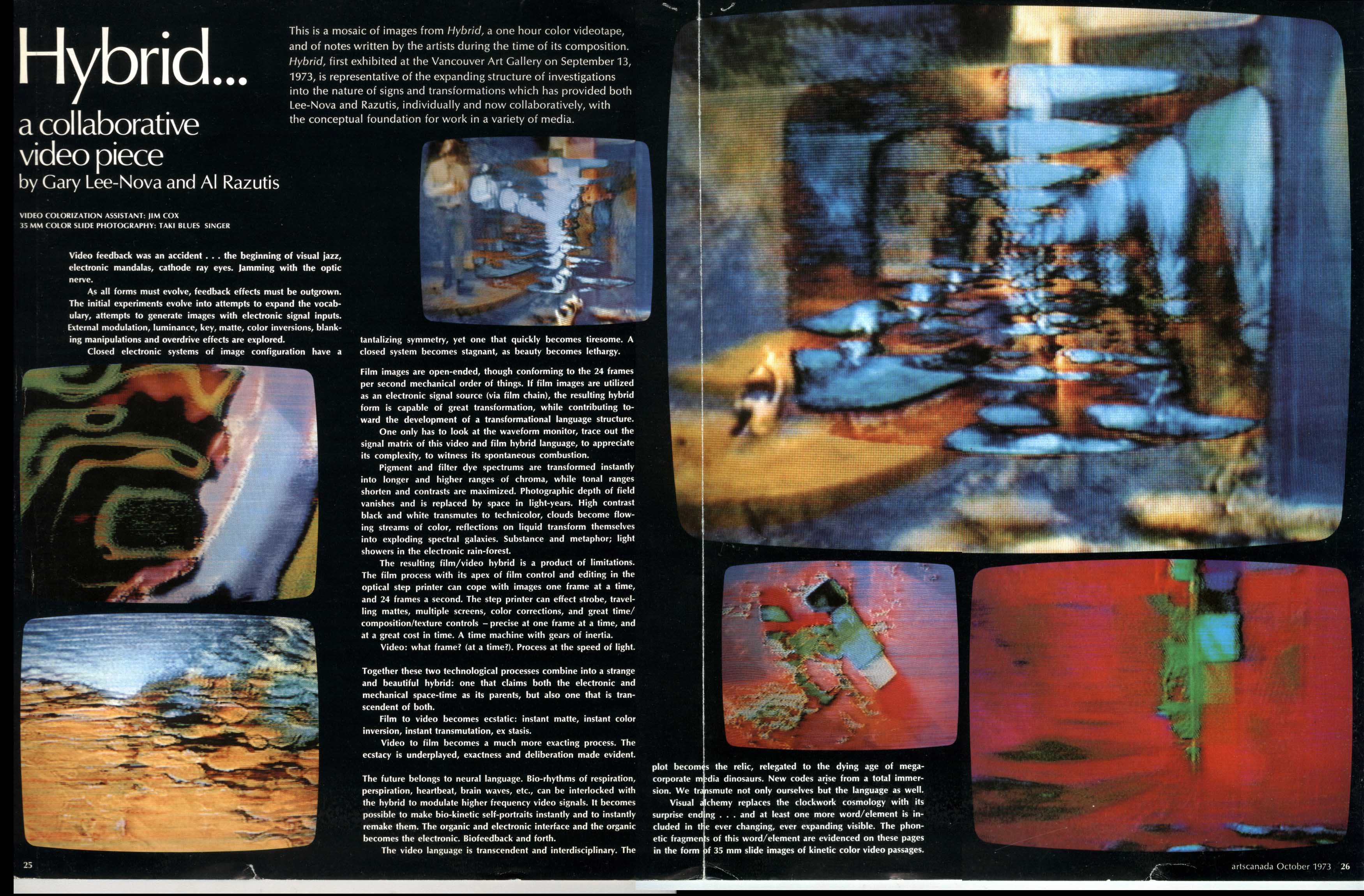
Arts Canada 1973 Video Issue - 'Hybrid' essay & graphics (large JPEG) -- Higher resolution PDF file
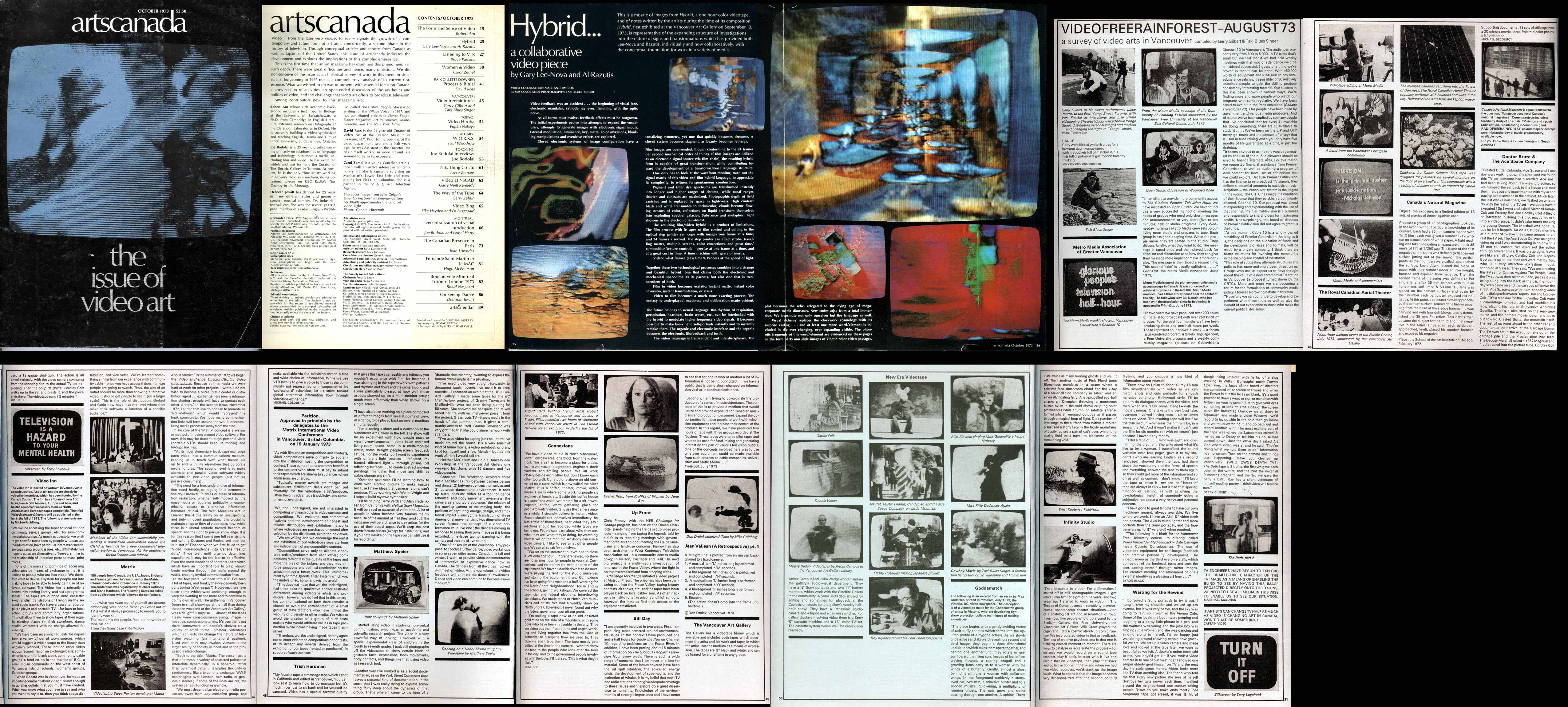
Arts Canada 1973 Video Issue - Full Section on Vancouver Video Art (large JPEG) -- Higher resolution PDF FILE
'FIREWORKS & WATERCOLOR / ABSTRACT'
4 min. color sound 1973 - Al Razutis prod./dir.
|
Additional experimetal works proceeding from these hybrids would be incorporated in film projected images that I did for the Royal Winnipeg Ballet production of 'What To Do Until the Messiah Comes', Vancouver 1975." (A.R.) Originals film printing elements at the Academy Archives, Hollywood, USA |
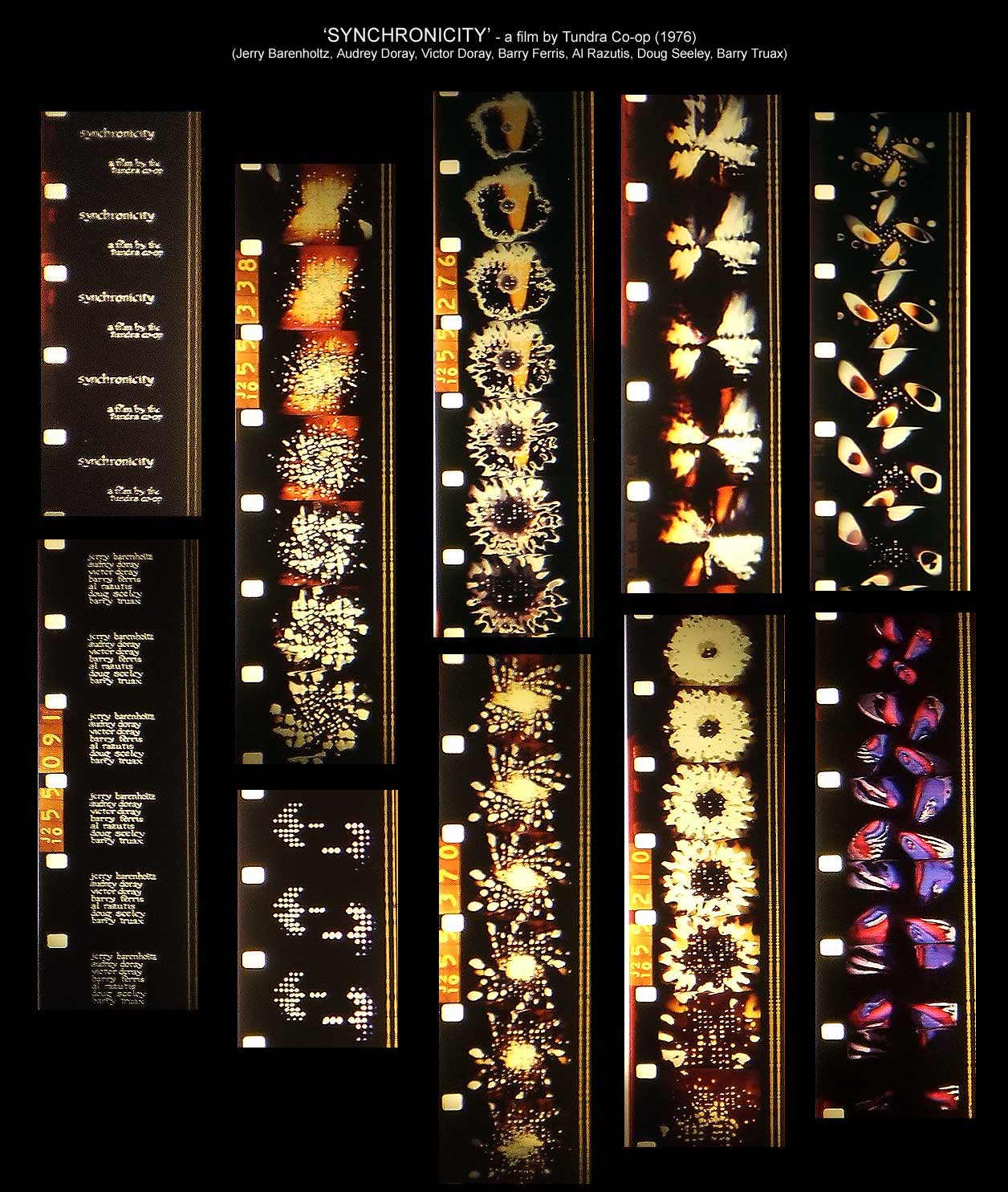
'SYNCHRONICITY' (1974)
Created by Tundra Co-op: Jerry Barenholtz, Audrey Doray, Victor Doray, Barry Ferris, Al Razutis, Doug Seeley, Barry Truax ( sound, 8 min. )
|
|
SYNCHRONICITY is a analog videosynthetic work incorporating early computer graphics (monocrome subjects), film loops subject to colorization, quantizing and feedback and was collaboratively created by Tundra Co-op, Vancouver, with Jerry Barenholtz and Doug Seeley providing the computer graphics and Al Razutis providing video synthetic mixing, and video editing. The electronic music track was composed and created by Barry Truax. Post production editing faciilities were donated by BCIT and Gene Lawrence. It has been recently added to the film archives after a single film print was discovered. This is a rare example of some of the earliest computer graphics work in Vancouver mixed with videosynthesis and video-effects with a electronic soundtrack. The work was completed on videotrape then transfered to 16mm film for distribution. Film printing elements at the Academy Archives, Hollywood, USA |
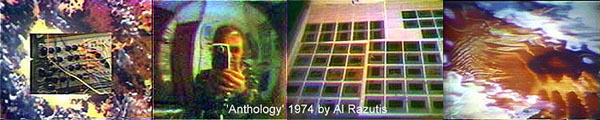
'ANTHOLOGY' 1972-1974
Featuring the following:
'Bio Portraits' and Visual Alchemy studio tours,
excerpts from hybrid film-video works: 'Vortex', '98.3
KHz: (Bridge at Electrical Storm', 'Le Voyage', 'Moon at Evernight...'
and the following films: 'AAEON', 'The Beast', 'Visual Alchemy',
'Melies Catalogue' approx. duration: 46 min.
)
|
|
ANTHOLOGY 1974 documents and presents film and video art created by Al Razutis at Visual Alchemy 1972 - 74. Beginning with an assembly of bio-rhythm / synthesizer experimental sequences, this highly ideosyncratic documentary includes excerpts from several films and videotapes by Razutis (listed above), studio 'tours', meditations, and strange digressions. Some of the sequences represent the only surviving video documentation from that era of avant-garde video at Visual Alchemy in Vancouver, Canada. Original elements (difficult to preserve) include footage shot on a 1/4" AKAI color portapak, 1" IVC studio sessions, and 1/2" SONY portapak and SONY AV-3650 and AV-5000 early color tapes. Production assistance provided by Evergreen State College (Washington) and Jim Cox. Previous distribution: Video Out, Vancouver |
'AURORA' (1974)
( sound, 6 min. )
1-2 min. excerpt videos from this work on YouTube:
|
AURORA is a analog videosynthetic work incorporating film loops subject to colorization, quantizing and layering and was created by Razutis at the video facilities of Evergreen State College (where he taught in 1972) and Vancouver (Visual Alchemy) utilizing his 'Felix' video synthesizer. Inspired by witnessing the 'aurora borealis' over Vancouver in the early 1970's, this short work is an early example of 'visual music' combining film sources (time lapse clouds, slow motion volcanic erruptions, water reflections) and videosynthesis, and was released as part of Videographics: Selected Works (1972-1974). Previous distribution: Video Out, Vancouver |

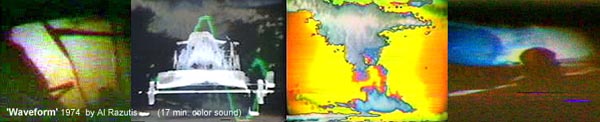
'WAVEFORM' (1974 - 1976)
('Waveform' and other shorts - 26 min. )
|
|
WAVEFORM documents and interprets art created using bio-feedback experiments conducted by Razutis and colleagues in Evergreen State College (where he taught in 1972) and Vancouver (Visual Alchemy). Artist was plugged into bio-monitoring devices (Beckman EEG, ECG) which performed 'voltage controlled' keying of looped film-video imagery in real-time synthesis. The resulting 'loop' (artist - real-time display - artist) became a 'feedback loop' which depended on artist's ability to affect change (breathing, heartbeat, brainwaves) on the synthesis process. The analog video era, which is celebrated graphically with ocean waves, oscilloscope waveforms and colorizing / keying techniques, along with white noise soundtrack elements, was certainly displaced by the digital video era. But in our universe, there can not be only digital binaries binary streams, but necessarily analog waveforms and functions that allow for propagation of energy and mind. This piece, like analog video feedback, is an analog composition celebrating waveforms. WAVEFORM is an early and unique example of 'interactive art' which nowadays includes virtual reality interactive interfaces, bio-scanning, and other technologies. In the 1970's analog era, these innovative approaches to art creation were limited only by available (borrowed or built) technologies. Production assistance provided by Evergreen State College (Washington) and Jim Cox. Previous distribution: Video Out, Vancouver |
"Waveforms and Synapses" - containing excerpts from WAVEFORM and SYNAPSE
4 min. 2020 on YouTube:
'SYNAPSE' (1976)
Bio-feedback Performance
Video 60 min., 1976
Distribution Edit version with titles, 28 min., 1979
40 sec. excerpt video on YouTube: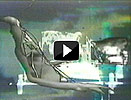

|
Before Virtual Reality (VR), before interactive digital graphics, there was bio-feedback and interaction with analog signals (video, audio, any waveform). And the 'medium' for this real-time interaction was the analog video-synthesizer, like the Felix, which was custom-built at Visual Alchemy by Jim Armstrong and Al Razutis. SYNAPSE (live broadcast bio-feedback performance piece on February 13, 1976, 8 p.m. Channel 10 Vancouver) is there to remind us of what happens when artist plugs himself into the bio-feedback machine in the 70's - artist as videosynthesizer, amplified by feedback loops, resulting in brain theta waves and accelerating and dangerous bio-rhythms. The earlier (WAVEFORM 1974 ) experiments with trying to achive 'alpha state' (brainwaves in the alpha region - EEG), a strange form of 'synthesizer assisted meditation', became less interesting (boring) than engaging with bio-feedback in a range of brainwave and bio activity. The feedback-loop (projected images mixed with modulated video syntheszer interpretations in real-time mix with the artist's response and ECG/EEG and galvanic skin reponse) went 'everywhere', including a 'broadcast failure' (the station went black for a minute after someone spilled coffee onto their broadcast 1" deck), attests to this being a 'work in progress' (later continued with CANADIAN SUNSET (1978) which featured synthesized 'biofeedback' with an office plant.) "I brought my 'performance' device (FELIX video synthesizer) into the broadcast studio at Channel 10 Vancouver one night for a live bio-feedback prime-time broadcast." (A.R.) SYNAPSE Performance assisted by: Tom Osborne, Jim Cox, Donna Graf, Jerry Barenholtz, Jim Bescott, Jeff Howard, Ron McInnis, Colin Wedgewood, Martin Truax, and Cable-10 Vancouver staff. Previous distribution: Video Out, Vancouver Original 60 min. program on 1 inch tape archived at the Academy Archives, Hollywood, USA |
'CANADIAN SUNSET' (1978)
Plant Video-synthesis Installation Video, 30 min., 1978
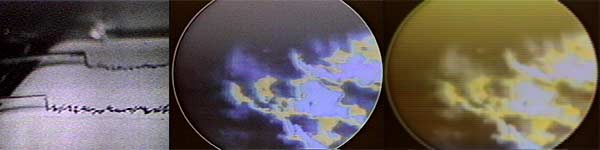
|
|
CANADIAN SUNSET featured a wired-up installation of Beckman EEG brain-wave monitor with electrodes attached to branch and stem of a office plant (a big leafy one!) in my faculty office at Simon Fraser University, 1978. The EEG sensor output was connected to voltage amplifiers and modulators which performed color keying fx on the output of the B&W video camera that looked 'out the window' at the sky in motion and light. The installation ran for 24 hrs, 7 days, as academic business was conducted 'as usual'. It was recorded by a time-lapse VCR in composite color (recording 'the performance', which included the plant-synthetic color keying. I had recently returned from Samoa ('the jungle'), had read 'Do Plants Have Feelings?' (don't laugh, it's a very interesting thesis), and decided to see for myself if a 24/7 recording of a plant's bio-potential readings (microvolts) could detect changes in 'attitude' (in the plant - certainly, there would be changes in my attitude towards the plant), and whether these could be used in a video-synthesis tape as 'art' or 'performance' or 'installation'. There were witnesses, including the Director of the Centre for the Arts, Dr. Evan Alderson (my boss), to the events: The common 'office' plant changing potentials and sensitivities (heightened during photo-synthesis daylight hours), sudden spikes of bio-potential ocurring and recorded by the EEG machine when I confronted it with scizzors, ready to "hack off a limb!". These events and this experimental installation certainly re-defined what a 'plant' is, especially in a university 'arts department', of which I was a new member. This tape was never distributed (attempts were made) and it marked a point of departure (from synaesthetic formalism) for me, one that would lead to future interests in 'political agitation' and 'avant-garde practices' (and the aesthetics of that which is 'ugly' to the 'fine arts'). This tape is referenced in Ghosts in the Machine: "This could have been a big-time money maker!" See also: Felix video synthesizer |
"ANTHOLOGY 1980"
30 min., sound - Produced and Directed by Al Razutis, 1980
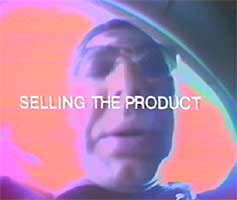
This tape was independently and 'with poetic license' produced in a 30 minute format for broadcast
on CBC - TV (Vancouver) as part of 'Independent
Filmmakers Showcase'.
It features a number of films
by Al Razutis presented in short extracts, fish-eye
lens walking shots, digressions, bio-graphical voice
overs and anti-commercial monologues deliberately constructed
to 'offend' the viewer's sense of watching TV. It was
broadcast in it's entirety, and subsequently distributed for several
years as a off-the-wall 'infomercial' tape on Razutis' films. 'Kind of like burning your bridges before they happen, which was the intention'. (A.R.) Excerpts from 20 films by Razutis spanning the 70's is presented along with real-time analog mixing interpretations and fragments from rarely seen works.
Previous distribution: Canadian
Fimmakers Distribution West (CFDW) / Moving Images, |
"INVESTIGATION OF A CITIZEN ABOVE SUSPICION"
60 min., stereo snd. - Produced and Directed by Al Razutis (with Mike Hoolboom) 1990
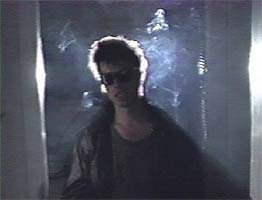 A sixty-minute one shot. Michael Hoolboom is interviewed / interrogated by Razutis in a Venice Beach apartment in 1980. The topic: the 'demise' of experimental film in Canada and the usurping of film production, exhibition, distribution, curating and critical history by an individual(s) normally protected from public scrutiny. Rather than skirting around the issues, this tape examines the facts behind this debacle, revealing for the 'first time' the intrigues, manipulations, intimidations that surrounded the Toronto film scene in the 80's. Hoolboom, as Experimental Film Officer at the Canadian Filmmakers Distribution Center in the 80's and privy to many of it's files and correspondences, is interrogated as a captive eye-witness to these events. Videotape also distributed as 'open letter' to Chicago, San Francisco, New York filmmakers. Previous distribution: Canadian Fimmakers Distribution West (CFDW) / Moving Images, Vancouver |
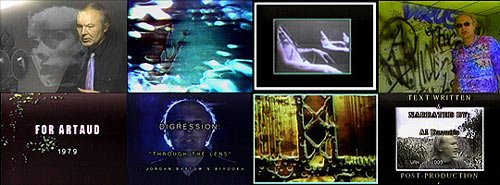
GHOSTS IN THE MACHINE22 min. Prod./Dir.
Al Razutis 1994-1996
Excerpts from this tape on YouTube:
Within all histories
of media (computer graphics, video, film), there are
predecessor forms, influences, prior works. This
context, including anti-censorship battles of the 80's
in Ontario, Canada, is remarked on in a 20 minute video-compilation
of works and interviews by Razutis titled "GHOSTS
IN THE MACHINE".
This is a tape compiled from various broadcast and original
art sources. It features a illustrated narration (by Razutis) touching on media art, history, and anarchist film art practices as evidenced in his works. Video synthetic film art and avant-garde art practices are the topics of this subjective anthology-documentary.
This videotape contains
short excerpts from 12 films and videos by Razutis, spanning 1970 to 1990, contains film and tv
interview fragments, and features a collage of voice-over commentary by Razutis
that covers film culture politics, avant garde works,
analog video and film technology and bio-feedback experiments
of the 1970's-80's. Selected interview material from
'THROUGH THE LENS' (Prod. G. Jordan-Bastow, F. Kiyooka),
a history of independent film-making in Canada, by permission of the producers. Previous distribution:
Video Out, Vancouver; V-Tape, Toronto
Collection copies of (panel of frames >>) 22 min. distribution version, from 3/4" Umatic, available on (sales >) DVD |
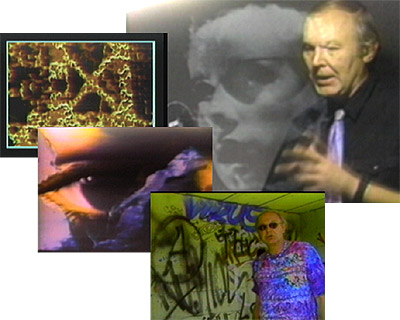
|
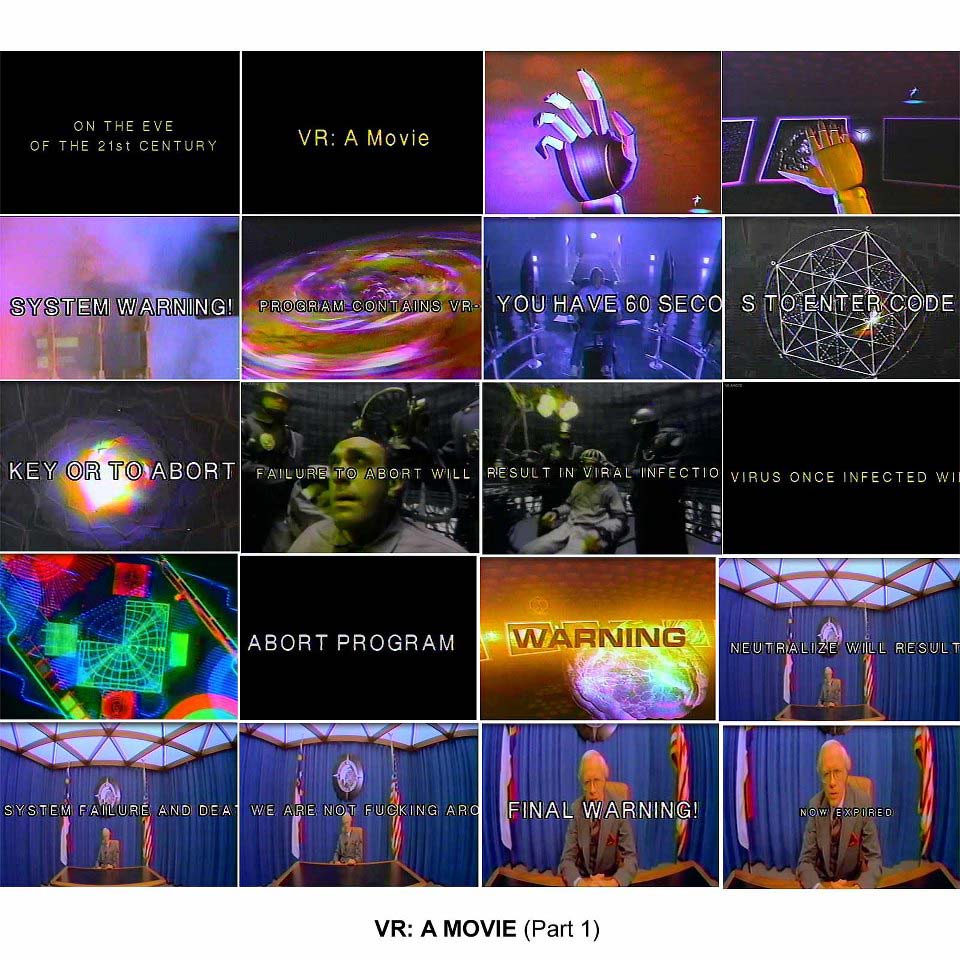
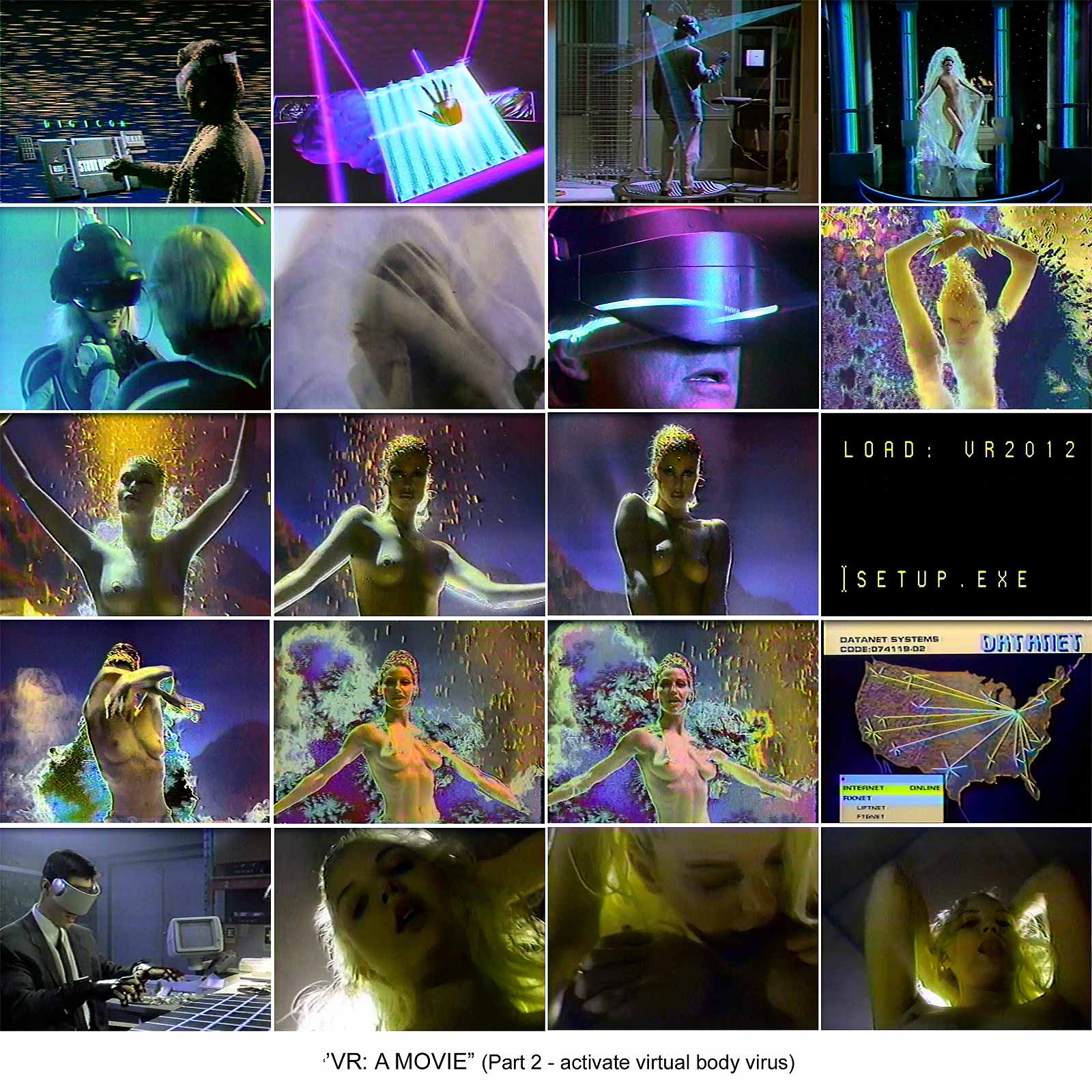
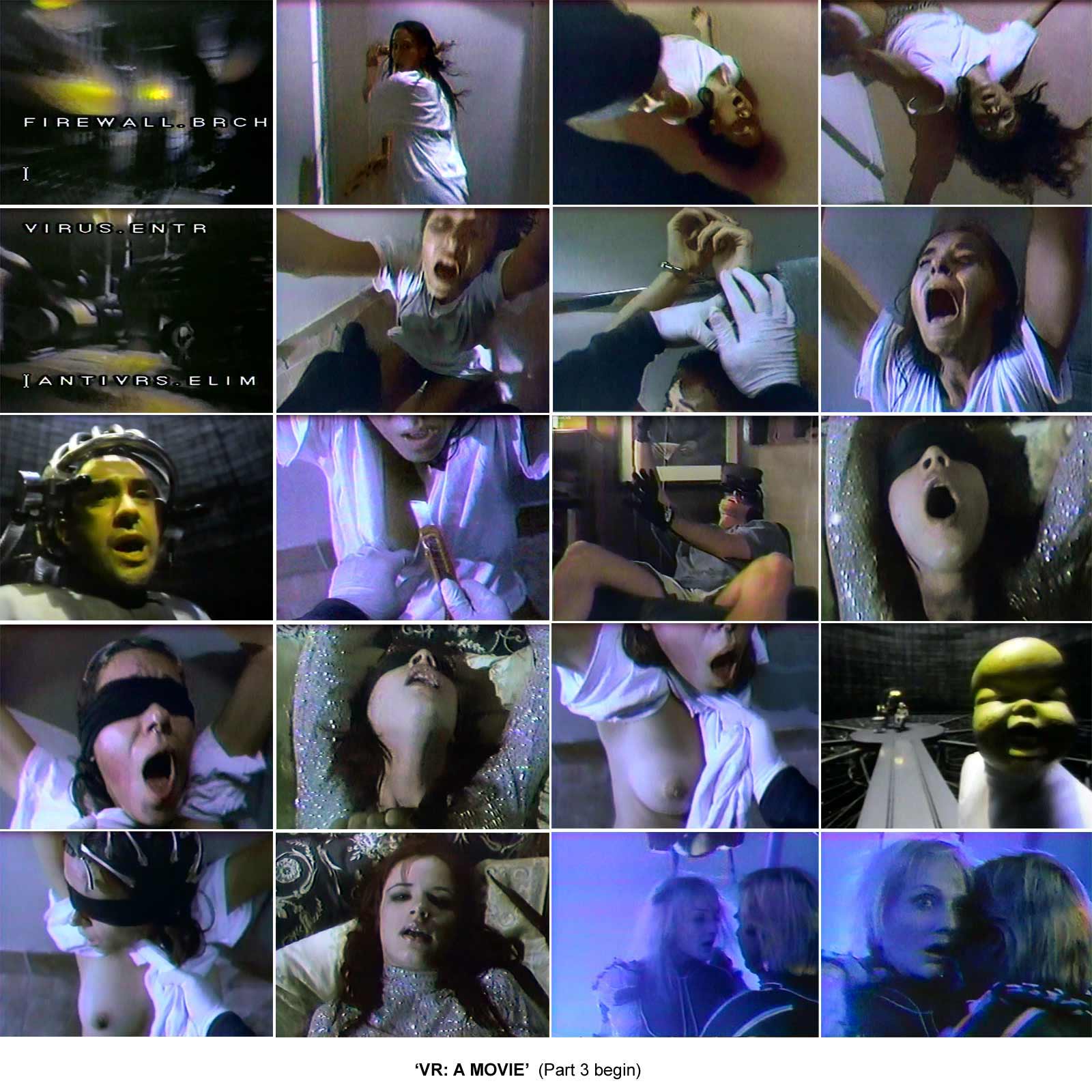
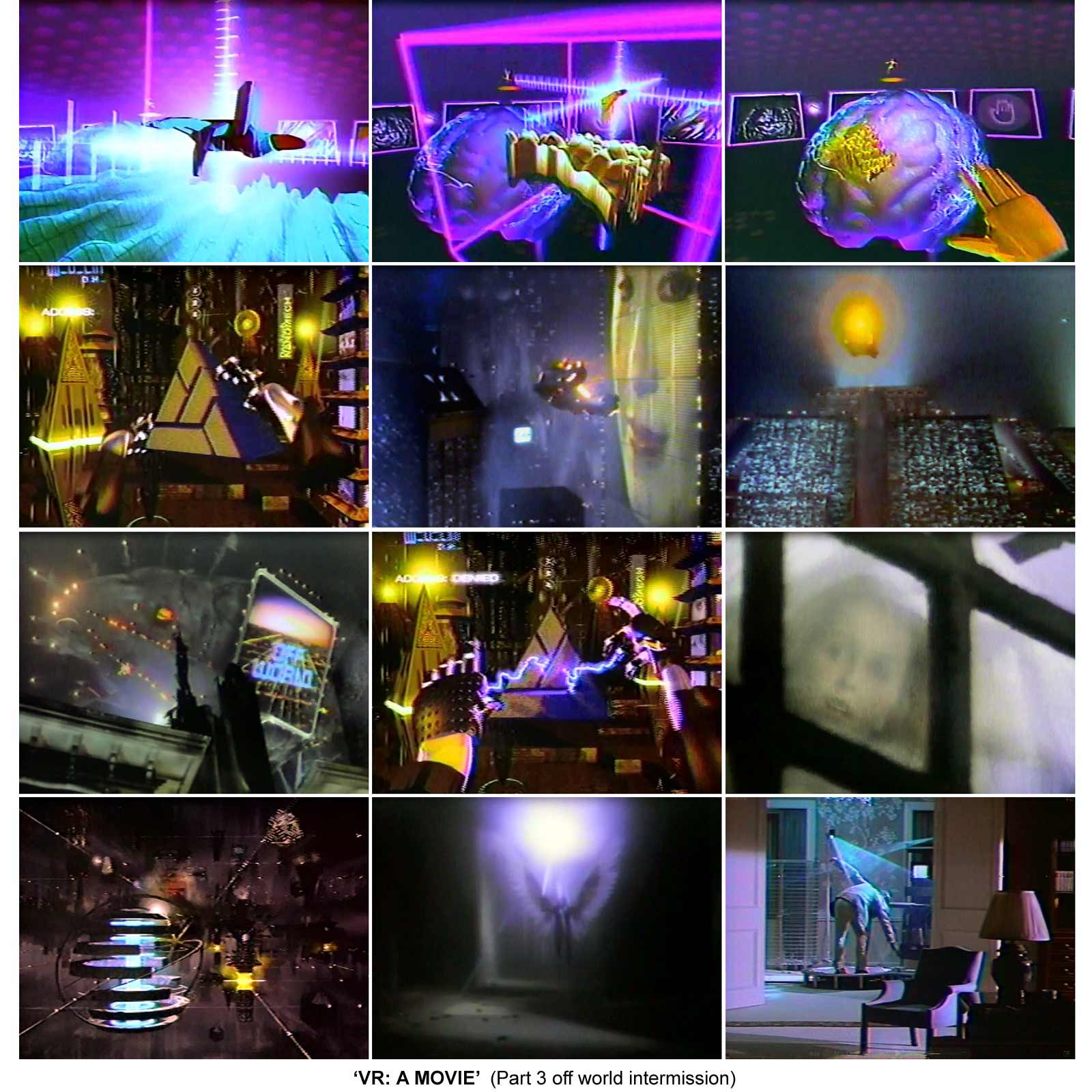
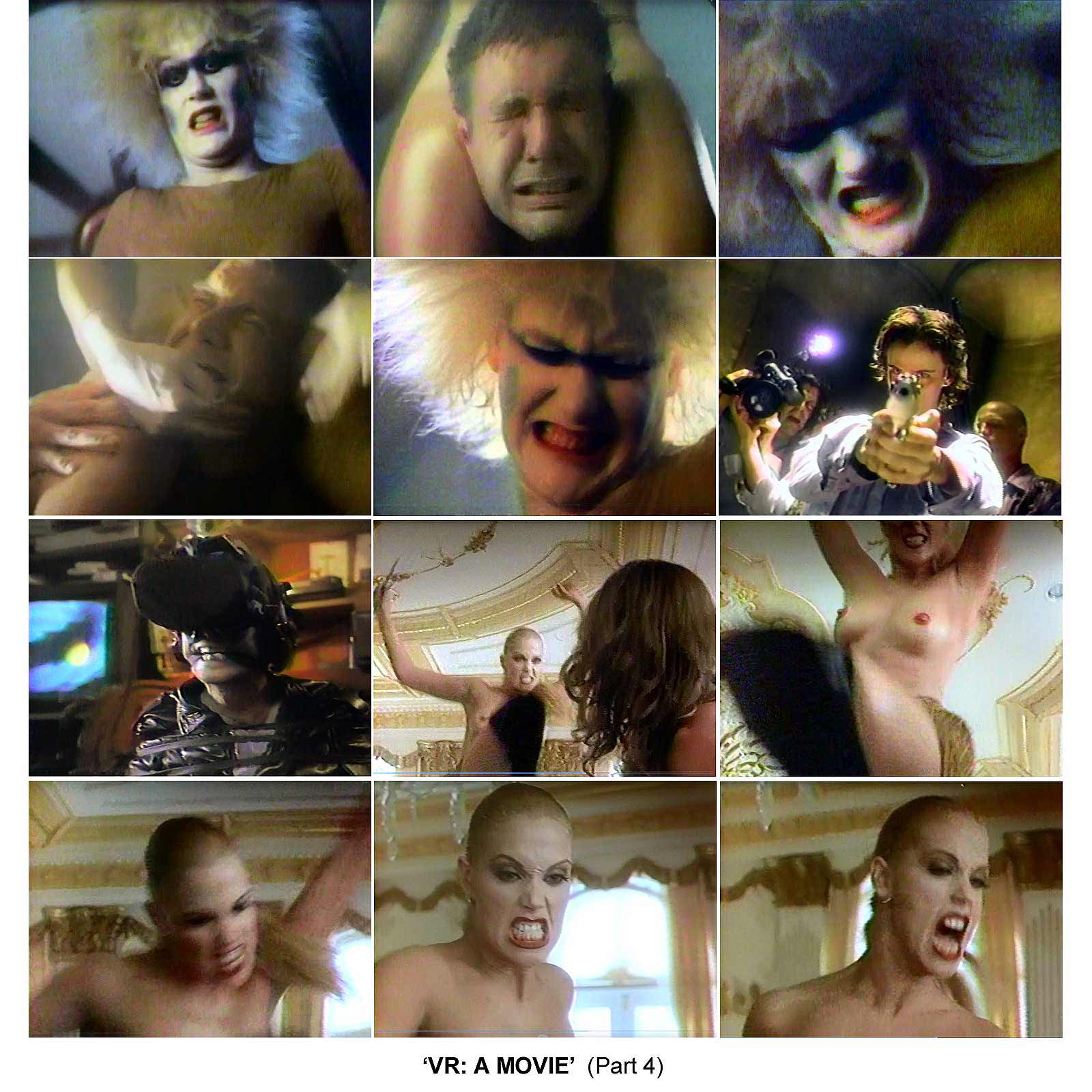
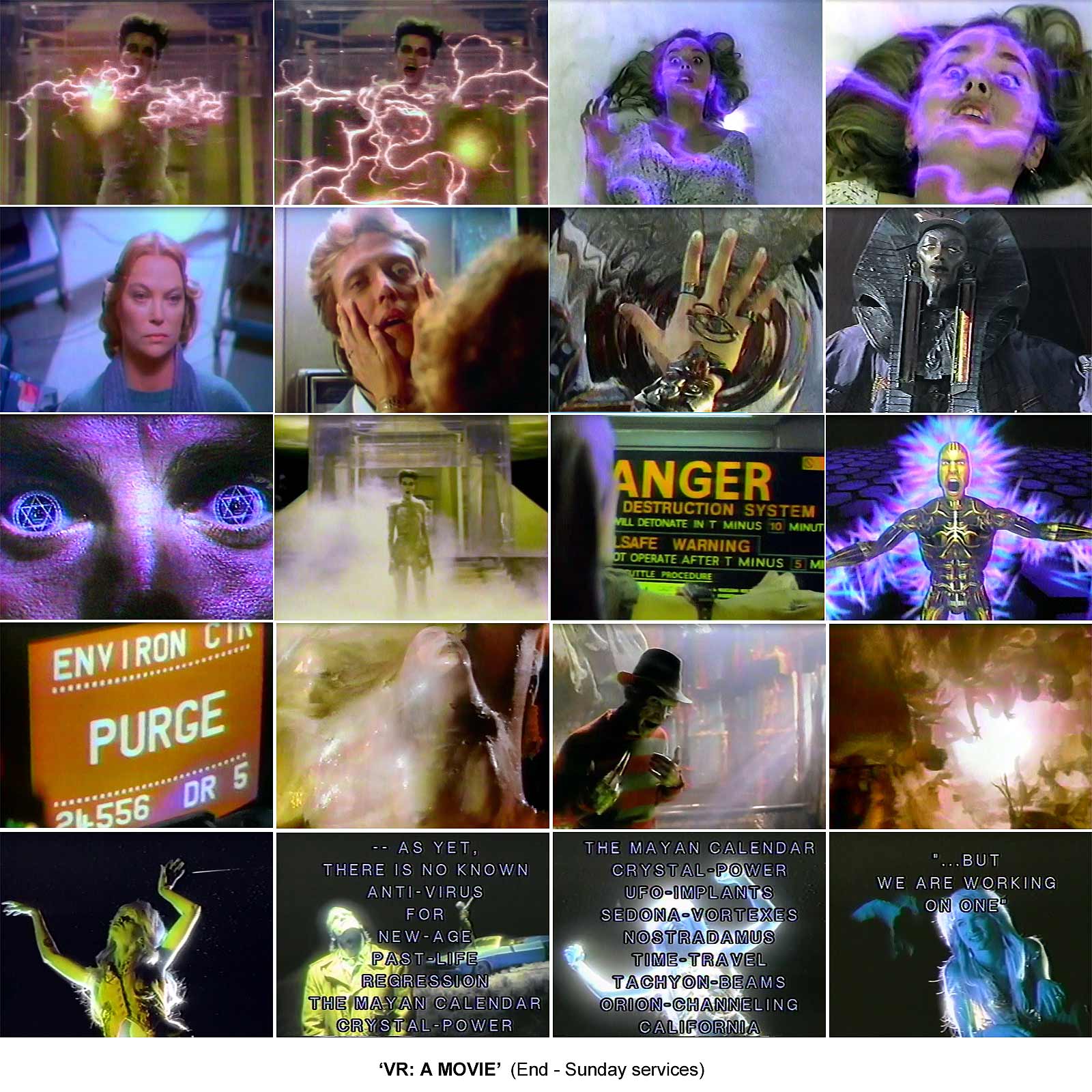
VR: A MOVIE16 min., VIDEOTAPE, 1996 |
|
>1 min. excerpt video on YouTube:
|
>1 min. excerpt video on YouTube:
|
VR: A Movie
takes up where AMERIKA and 'A Message From Our Sponsor' left off, and is a compilation
(stock/appropriated footage) from 20 features, particularly those that depict or deal with 'virtual
reality' and synthetic worlds of shifting metaphors. It is also a critique of VR
mythologies, especially as they depict women and slaves to a tech ego, and a criticism of the narcissism, power-tripping, and the collective
fascination that Hollywood film has with its own techno-dick.
Sections by theme: Part 1: 'The Set up', Part 2: 'Virus Activation', Part 3: 'Cut to the Chase', Intermission: 'Off World', Part 4: 'Punishment Park', Part 5: 'Meet Your Maker' Taking as a further trip into 'metalanguage', where previous films in 'Amerika' had left us, and now taking it into virtual reality, the tech and their worlds, right from screen to a 'situationist' re-mix, with some new and extreme forms of both psycho and semiotics, this extreme example of montage and appropriation delivers us to a dystopian view of VR.
The required (purchase) agreement
stipulated that once this video was obtained and viewed
by the buyer, it "must be copied, added to, and re-distributed
(on the net, or elsewhere)":. "There was only one buyer of this work before
it was retired from distribution. That one buyer was William
C. Wees, whose essay
on 'Amerika' stunned me with his insight into
the film and its function in avant-garde art. Maybe he
was curious 'what happens next?' He's got a one-of-a-kind
to add to his collections and thoughtful interventions
on behalf of montage film artists, and us agonists of
the avant-garde." (XAR)
Previous distribution of VR: A MOVIE: 

Video Out, Vancouver; V-Tape, Toronto; film-maker self distribution
EURO - TRIPTYCH / 200219 min., various original elements,
2002
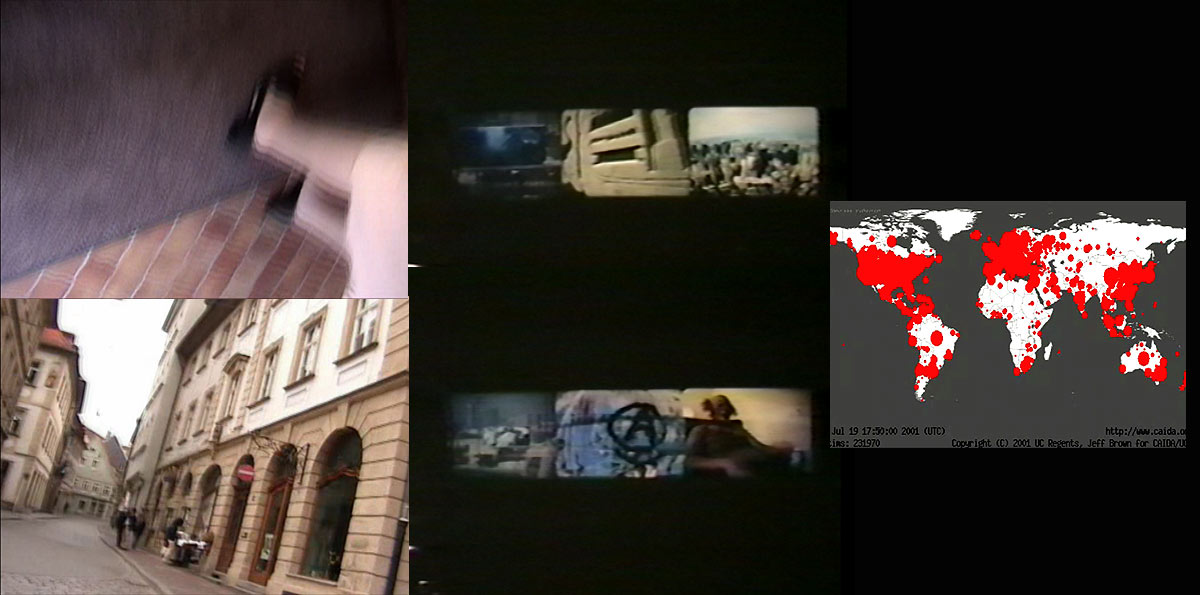
EURO - TRYPTYCH/2002 was completed after the conclusion of Razutis' 2002 retrospective shows at EMAF - Osnabruck, Germany'. There are three-shorts contained withing this tape, each with different subject matter and form.
1946
- 2002 / LEARNING TO WALK
- 7 min. 'AMERIKA'
x 3 - NANTES 1997 - 9 min. '99
CODE RED BALOONS' 2002 - 4 min.
Collection copies of 19 min. distribution version< available on (sales >) DVD |
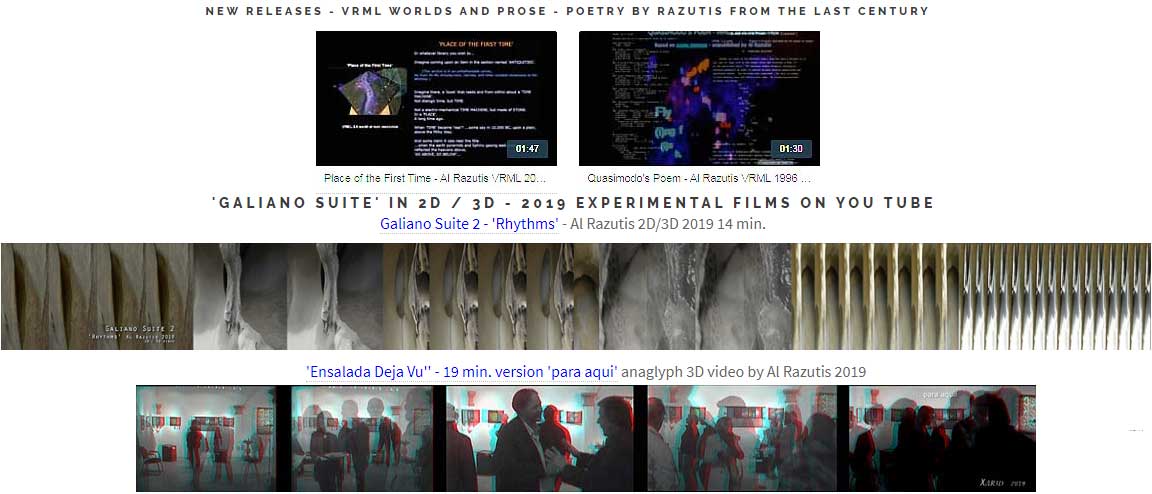
New Releases 3D Videos - Experimental Subjects
If you can't find a film or video, see:
Complete Lists of works in all medias
For only 3D films by Razutis see Razutis 3D Video Art List
'On stereoscopic 3D/4D and holographics' essay by Al Razutis 2007
3D Video Documentary on Holographic Artists
'When is 3D Video an Art?'
ANALOG NTSC 3D VIDEO VIEWING - EXHIBITION REQUIREMENTS (2004)
> HISTORY & EXHIBITIONS OF THIS WORK
'VIRTUAL IMAGING'
3-D stereoscopic video, 36 min., stereo snd. - Produced and Directed by Al Razutis, 1996-7

|
|
|
|
|
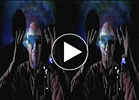
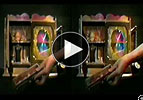
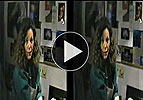
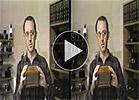
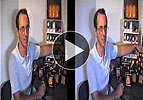
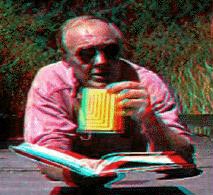 3D-ANAGLYPH Use red/blue glasses - click for image gallery The subject is 'virtual space' and imaging, via 3D stereoscopic photography, holography, and virtual reality; the host is Al Razutis and a 'twisted' take on Alice in 'wonderland'. This videotape is rich in imagery, complexity, strange juxtapositions of stereoscopic 3-D space and the more familiar 2-D space. It is both a 'narrative' about stereoscopic 3D technology and viewing, holographic image creations (featuring lab tours and holographic works by Melissa Crenshaw, Gary Cullen, Al Razutis - Vancouver), and a strange 'poetic narrative' about what happened when a fictional 'Alice' went through the 'looking glass' and discovered.....'virtual reality'. This tape covers some of the aspects of the history of stereoscopy, the lab technologies and arts of holography, and includes social commentary on the "narcissisms" and violence inherent in commercial cinema's virtual-reality landscape. 'West-Coast Artists in Light' Vo. 3 3D video of holographic artists (featured above) 'Virtual Imaging' 3D Gallery of Stills Prize Winner at 1997 So. Calif. 3D film/video fest. Previous distribution: Video Out, Vancouver; V-Tape, Toronto |
'DEAN FOGAL: CORPOREAL ART'
3D
stereoscopic video, 1997 12 min.
Produced and Directed by Al Razutis, in collaboration with
Dean Fogal

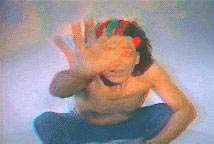 3D-ANAGLYPH of video frame - Use red/blue glasses - click for image gallery Stereographic video documentation and
interpretation of two "corporeal mime"
performances by Dean Fogal. Mr. Fogal is an accomplished
mime artist and teacher, who studied corporeal mime
with Etienne Decroux and Marcel Marceau
in Paris. This tape contains two short mime performances -
'Chairing' and 'Walking on Air' - and forms
the basis of an ongoing collaboration in 3D video between
a mime choreographer-performer and 3D video-maker. A unique blend of studied movement within a stereoscopic 'space' where 'words no longer suffice to convey meaning.' Prize Winner at 1997 So. Calif. 3D film/video fest. Previous distribution: Video Out, Vancouver, V-Tape, Toronto 1 min. excerpt on YouTube:
|
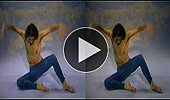
"DISCOVERY OF LOSS"
3D
stereoscopic video, 12 min., 1997
Produced and Directed by Al Razutis, in collaboration with
Dean Fogal
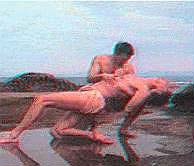 3D-ANAGLYPH of Video Frame
 Performance by Dean Fogal and Anthony
Artibello.
A fusion between studied movement and 3D stereographic forms with an emphasis on the physical body mapping space and emotion. Videotaped on location on Saturna Island, BC, Canada. Prize Winner at 1997 So. Calif. 3D film/video fest. Previous distribution: Video Out, Vancouver; V-Tape, Toronto |
'SHADOWS OF LOVE'
3D
stereoscopic video, 12 min., 1997
Produced and Directed
by Al Razutis, in collaboration with Dean Fogal

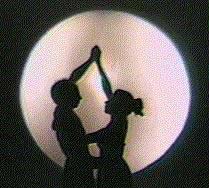
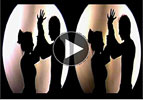
Performance by Daniel Lomas and Sue Biely. This tape features a strange 'love duet' set to 'funeral' music; two characters, as shadow figures in front of a light orb, recreate aspects of 'relationship', the coming together and coming apart. In its minimal set and choreography of poses, this dance piece expresses a surrealism of an 'embossed living cut-outs' engaged in the poses of life and love. Previous distribution: Video Out, Vancouver; V-Tape, Toronto |
1 min. excerpt on YouTube:
ARCHIVED 3D VIDEO ART SHORTS by Al Razutis 1996-1999
View in 720p: 13 min. sampler reel in anaglyph 3D on VIMEO 'Analog 3D Video Art' by Al Razutis - 1990s

Page - descriptions - links to new 2019 3D film releases
|

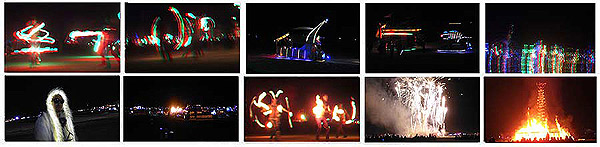
|
Avant-Garde Films by Razutis on YouTube |
3D videos by Razutis on YouTube |
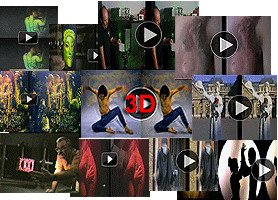
* Films - Videotapes in Distribution DVDs of these works in Distribution
ESSAYS:
'These Films - This Site'
Critical Writings on Film
History of Visual Alchemy
HOME
[ TOP OF PAGE ]